
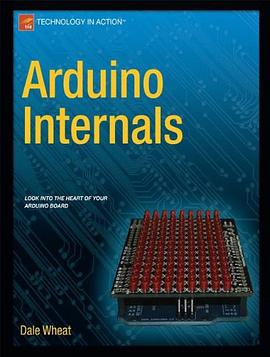

具体描述
Arduino Internals guides you to the heart of the Arduino board. Author Dale Wheat shares his intimate knowledge of the Arduino board--its secrets, its strengths and possible alternatives to its constituent parts are laid open to scrutiny in this book. You'll learn to build new, improved Arduino boards and peripherals, while conforming to the Arduino reference design. Arduino Internals begins by reviewing the current Arduino hardware and software landscape. In particular, it offers a clear analysis of how the ATmega8 board works and when and where to use its derivatives. The chapter on the "hardware heart" is vital for the rest of the book and should be studied in some detail. Furthermore, Arduino Internals offers important information about the CPU running the Arduino board, the memory contained within it and the peripherals mounted on it. To be able to write software that runs optimally on what is a fairly small embedded board, one must understand how the different parts interact. Later in the book, you'll learn how to replace certain parts with more powerful alternatives and how to design Arduino peripherals and shields. Since Arduino Internals addresses both sides of the Arduino hardware-software boundary, the author analyzes the compiler toolchain and again provides suggestions on how to replace it with something more suitable for your own purposes. You'll also learn about how libraries enable you to change the way Arduino and software interact, and how to write your own library implementing algorithms you've devised yourself. Arduino Internals also suggests alternative programming environments, since many Arduino hackers have a background language other than C or Java. Of course, it is possible to optimize the way in which hardware and software interact--an entire chapter is dedicated to this field. Arduino Internals doesn't just focus on the different parts of Arduino architecture, but also on the ways in which example projects can take advantage of the new and improved Arduino board. Wheat employs example projects to exemplify the hacks and algorithms taught throughout the book. Arduino projects straddling the hardware-software boundary often require collaboration between people of different talents and skills which cannot be taken for granted. For this reason, Arduino Internals contains a whole chapter dedicated to collaboration and open source cooperation to make those tools and skills explicit. One of the crowning achievements of an Arduino hacker is to design a shield or peripheral residing on the Arduino board, which is the focus of the following chapter. A later chapter takes specialization further by examining Arduino protocols and communications, a field immediately relevant to shields and the communication between peripherals and the board. Finally, Arduino Internals integrates different skills and design techniques by presenting several projects that challenge you to put your newly-acquired skills to the test! Please note: the print version of this title is black & white; the eBook is full color. What you'll learn * To understand the internal heart of your Arduino board * How to replace parts of the Arduino board with new, more powerful elements * How to build a new Arduino board * How to build your own peripherals and shields * How to optimize your own code and existing libraries to run on your own Arduino device Who this book is for This book is geared towards intermediate-level Arduino hackers and makers, embedded system designers who want to know what Arduino is about, hardware designers who would like to change Arduino to suit their own requirements, and developers who would like to write optimized Arduino software. Table of Contents * Hardware * Software * Atmel AVR * Supporting Hardware * Arduino Software * Optimizations * Hardware and Software Combined * Example Projects * Project Management * Hardware Design * Software Design * Networking * Tabletop Robot Project
作者简介
目录信息
About the Author ...................................................................................................... xv
About the Technical Reviewers ............................................................................... xvi
Acknowledgments .................................................................................................. xvii
Preface .................................................................................................................. xviii
■Chapter 1: Hardware ............................................................................................... 1
■Chapter 2: Software ............................................................................................... 25
■Chapter 3: Atmel AVR ............................................................................................ 39
■Chapter 4: Supporting Hardware ........................................................................... 71
■Chapter 5: Arduino Software ................................................................................. 89
■Chapter 6: Optimizations ....................................................................................... 99
■Chapter 7: Hardware Plus Software .................................................................... 133
■Chapter 8: Example Projects ............................................................................... 165
■Chapter 9: Project Management .......................................................................... 213
■Chapter 10: Hardware Design .............................................................................. 231
■Chapter 11: Software Design ............................................................................... 255
■Chapter 12: Networking ....................................................................................... 281
■Chapter 13: More Example Projects .................................................................... 305
Index ....................................................................................................................... 359
· · · · · · (收起)
读后感
用户评价
阅读体验上,这本书的文字风格极为严谨,几乎没有一句废话,读起来像是在啃一块高密度的知识硬骨头,但每啃下一块,都会有极大的满足感。我尤其欣赏作者在逻辑架构上的组织方式,它没有采用传统的按功能模块划分章节,而是更倾向于从硬件的物理结构出发,层层递进地揭示软件的实现。例如,在讲解模拟数字转换器(ADC)的章节中,作者首先还原了ADC模块的内部框图,接着阐述了采样时钟的确定性影响,最后才引入了`analogRead()`函数在库层面的封装。这种自底向上的叙事结构,对于系统架构师类型的人来说,无疑是最舒服的。我发现自己花了大量时间在对照书中的图表和自己电脑上打开的Datasheet进行交叉验证,这让我对“芯片级编程”有了更具体的概念。书中的插图虽然是黑白的,但其信息密度极高,每一个引脚标记、每一个信号流向都经过了精心的设计,绝非市面上那些为了凑页数而堆砌的示意图可比。对于那些想跳出IDE图形界面,直接与硬件“对话”的工程师而言,这本书提供了必要的理论基石和实战参考。
评分这本书的真正价值,我认为在于它对“生态系统”的解构。它不仅仅关注Arduino UNO这个特定的载体,而是延伸到了整个AVR生态的通用原理。作者在讨论I/O操作时,清晰地区分了端口(PORT)、数据寄存器(DDR)和输入引脚(PIN)之间的关系,这种对“抽象层”的细腻描绘,让我对抽象化编程的利弊有了更深刻的认识。举例来说,书中对软件实现的效率分析非常到位,它会对比直接操作寄存器与使用标准库函数在执行时间上的微小差异,并解释这种差异背后的时钟周期开销。这种对“微优化”的追求,是专业驱动开发者才会关注的细节。此外,书中还穿插了对编译器优化选项的讨论,如何通过GCC的不同参数来控制代码的生成,使其更好地适应资源受限的微控制器环境。这本书更像是一本深入Cortex-M系列之前的“预备课程”,它建立了一种严谨的、面向硬件的编程思维框架,让你在接触更复杂的ARM架构时,能够迅速找到感觉,理解它们之间继承和演进的关系。
评分最让我惊喜的是,这本书对“实时性”的探讨。在讨论中断处理时,作者并没有停留在“如何屏蔽和开启中断”的层面,而是深入分析了中断服务程序(ISR)的最大执行时间限制、上下文切换的开销,以及如何利用低延迟的硬件机制来保证关键任务的响应。书中提到了一种利用DMA(直接内存访问)来卸载CPU处理大量数据传输的方法,并通过一个复杂的缓冲机制设计实例,展示了如何用近乎零CPU干预的方式完成高带宽的数据采集。这对于需要设计高精度数据采集系统或实时控制系统的工程师来说,是极其实用的信息。这本书的深度在于,它让你明白,在资源受限的环境中,性能的提升往往不是通过更快的时钟频率实现的,而是通过更聪明的资源调度和更精妙的硬件特性利用。总而言之,《Arduino Internals》是一部技术深度极高、对读者要求严格,但回报丰厚的专业著作,它为你打开了通往底层世界的另一扇大门。
评分这本书的难度曲线相当陡峭,毫不留情地将“小白”和“有志者”分离开来。对于初学者,我估计光是理解前三章中关于存储器映射和总线访问的概念,就可能需要花费数周时间。我记得书中有一些关于Flash存储器读写操作的描述,涉及到页擦除和扇区编程的复杂时序,这部分内容对于理解固件更新和OTA(空中下载)技术的底层逻辑至关重要。我尝试按照书中的例子手动编写一个小的Flash写入函数,中间遇到了无数次因时序不匹配导致的死机,但每一次错误都促使我更深层次地去挖掘寄存器状态机的细节。这种“痛并快乐着”的学习过程,恰恰是这本书的魅力所在——它强迫你直面硬件的残酷现实。它不会用“拖拽控件”这种轻松的方式来分散你的注意力,而是直接将你抛入到时序图和寄存器地址的海洋中,让你学会游泳。对于想要从事嵌入式底层驱动开发的人来说,这本书的价值远超其定价。
评分这本《Arduino Internals》的书籍,从头到尾都散发着一股浓郁的技术气息,对于那些渴望深入了解微控制器工作原理的电子发烧友来说,简直就是一本“武功秘籍”。我原本以为自己对Atmel AVR架构已经有了相当的了解,但这本书的深入剖析让我汗颜。它不仅详细讲解了引导加载程序(bootloader)的加载过程,更令人称奇的是,作者居然花了大篇幅去解析SRAM和EEPROM的底层操作机制。我记得有一章专门讨论了中断向量表的重定位,那段描述极其详尽,甚至配上了汇编层面的代码注释,让我这个平时只停留在C++层面的“拿来主义者”大开眼界。读完之后,我再看任何一个简单的`digitalWrite()`函数,都会下意识地去思考底层寄存器是如何被操作的,这种思维的转变是任何入门级教程都无法给予的。特别是关于定时器/计数器的配置,书中将CTC、波形发生模式以及预分频器的设置讲解得透彻入微,让我终于能摆脱官方库的束缚,精确控制脉冲宽度和频率,这对于我后面开发一个高精度信号发生器项目至关重要。如果说市面上大多数Arduino书籍教你“怎么做”,那么这本书真正教你的是“为什么能这么做”。
评分 评分 评分 评分 评分相关图书














本站所有内容均为互联网搜索引擎提供的公开搜索信息,本站不存储任何数据与内容,任何内容与数据均与本站无关,如有需要请联系相关搜索引擎包括但不限于百度,google,bing,sogou 等
© 2026 onlinetoolsland.com All Rights Reserved. 本本书屋 版权所有