
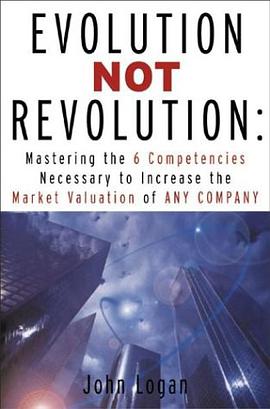

具体描述
John Logan, founder of the highly regarded boutique consulting company, Aberdeen Group, presents Evolution Not Revolution, a strategic call to arms for executives and managers to use their imaginations to envision the evolutionary steps that will make their company a winner and improve its position in comparison to the competition. Every 2-3 years business executives become subject to the latest "revolutionary" information technology overhaul, and many executives feel they need a revolutionary strategy to match. Following this proverbial "Hail Mary" approach to strategy setting (say prayer and then initiate a radically new strategy) is generally as unsuccessful in business as the Hail Mary pass is in American football. Competence in managing the use of advanced technologies to create and execute superior strategies gives an organization a powerful advantage over competitors who still treat information systems as an overhead cost - not a capability with which to profitably grow revenues. Yet while these executives can calmly and rationally deal with such issues as annual budget cycles and personnel problems, they become frazzled and emotional when faced with the questions of how to make technology work for them. This book will be their bible for successfully guiding them through the traumas associated with planning and deploying new information technologies while at the same time profitably growing their business - and increasing the market valuation of their company. For executives to successfully obtain the benefits and objectives of evolutionary planning and management, Logan introduces them to the six competencies: 1) Operational acumen to know how to successfully transform the company's products, services, distribution channels, and resource acquisition methods to meet the changing preferences of its customers; 2) Marketing skills to establish loyalty bonds with current customers, seduce new customers away from traditional competitors, and create new classes of customers that the business has never before attempted to reach; 3) Negotiating and communications talents to build a common vision of the future with the best supplier and distribution-channel business partners to both create the most effective economic ecosystem possible as well as to pre-empt competitors from gaining strong and highly supportive allies; 4) Financial smarts to change in a manner that maximizes the company's economic returns; 5) Management discipline to execute on time and across all organizational boundaries; 6) Information systems management skills to identify and implement the wide range of possible technical components into a stable, secure, flexible, and expandable operational information systems architecture - on time and within budget. By mastering the six competencies, executives can build winner enterprises by claiming the largest share of its target customer base and the highest profitability their industry.
作者简介
目录信息
读后感
用户评价
从结构上来看,这本书的章节划分极具匠心,它不是按照时间线索进行线性叙述,而是围绕几个核心的“作用机制”进行模块化探讨。例如,一个章节专门讨论“信息反馈的滞后性如何影响决策的修正速度”,另一个章节则聚焦于“小群体的内部规范如何抵抗外部的压力”。这种机制导向的分析方法,使得本书的论点具有极强的跨学科适用性。我尝试将书中关于生物进化中的“基因漂变”的原理,去类比理解现代商业市场中某些非理性趋势的形成,发现竟然有着惊人的契合度。这种高层次的抽象和类比能力,体现了作者深厚的跨界知识储备。而且,作者在每一个章节的末尾,都会设置一个小型的“思考练习”环节,虽然不是直接的问题,但提供的反向论证角度总是能巧妙地将读者的思维从既有的舒适区推向更深、更具挑战性的领域。
评分这本书最大的价值,在于其对时间尺度和因果链条的重新审视。很多关于社会变迁的论述往往聚焦于“决定性时刻”,那些签署条约、发动战争或发布宣言的瞬间。然而,本书却以一种近乎“慢镜头”的方式,迫使读者关注在这些关键事件发生之前,那些漫长而低调的准备阶段。我特别欣赏作者对于“临界点”理论的批判性解读。他没有完全否定临界点的存在,而是强调,一个临界点之所以能够被触发,背后是多年来无数次“差点就成功”的尝试所铺就的土壤。这种对“失败”和“不完全成功”的重视,是这本书区别于其他同类作品的关键点。它教导我们,真正的进步往往隐藏在那些没有被历史记录的、微不足道的日常实践之中。读完之后,我对看待任何重大的社会现象,都多了一层溯源的耐心和细致入微的观察角度,不再满足于表面的快速结论。
评分我对这本书的语言风格感到非常惊喜,它没有采用那种高高在上、充斥着晦涩术语的学术腔调。相反,作者的文笔流畅且富有画面感,读起来更像是在听一位知识渊博的长者讲述他毕生的观察心得。书中穿插的一些比喻尤其精妙,比如将社会结构的演化比作河流的分叉与汇流,形象地说明了看似随机的路径依赖是如何塑造出最终的稳定态的。在讨论组织变革时,作者运用了一种类比手法,将僵化的企业文化比作冰川,强调了持续的、微小的压力才能最终导致深层结构的移动,而不是一次突然的地震。这种叙事策略极大地降低了理解门槛,使得即便是初次接触相关理论的读者,也能迅速抓住核心论点。更难能可贵的是,作者在保持学术严谨性的同时,始终保持着一种克制而审慎的乐观态度,避免了过度简化的宿命论。整本书的阅读体验,就像是在一个光线充足、陈设雅致的图书馆里,被一位充满热情的讲解人带着进行一次知识漫步。
评分这本书的叙事节奏把握得恰到好处,仿佛作者是一位经验老到的登山向导,引领着我们穿梭于复杂的概念迷宫之中。开篇便以一种近乎哲学思辨的口吻,抛出了关于“渐进性变革”与“断裂性飞跃”的经典对立,但不同于以往那些枯燥的理论辩白,作者巧妙地将其融入到一系列引人入胜的历史案例中。比如,书中对工业革命早期技术迭代的细致描摹,就极大地拓宽了我的视野。我原以为技术革新总是一蹴而就的巨大突破,但阅读后才意识到,那些所谓的“革命性”发明,往往是无数微小、看似不起眼的改进和试验积累的必然结果。作者没有满足于仅仅罗列事实,而是深入剖析了驱动这些微小变革的社会心理和经济动力。尤其是关于早期工匠圈子内部知识传播方式的论述,充满了人类学式的洞察力,让人仿佛能闻到作坊里木屑和油脂的味道。这种对细节的执着,让整本书的论证充满了坚实的地面感,绝非空中楼阁般的空泛说教。它成功地将宏大的历史叙事,拆解成了可触摸、可理解的个体行动序列。
评分这本书的整体情绪基调是内敛而深刻的,它避开了对“宏伟蓝图”的过度渲染,转而聚焦于“过程的内在逻辑”。它不像某些畅销书那样,试图提供一套立即可用的“变革秘籍”或“速成指南”。相反,它更像是一部严谨的工具书,为理解复杂系统的运作提供了一套成熟的方法论。作者在论证过程中展现出的那种近乎偏执的求真精神,令人肃然起敬。书中对那些看似不证自明的常识进行了反复的解构和重组,直到剥露出其在特定情境下的脆弱性。举例来说,对于“效率最大化”这一现代信条的探讨,作者并非全盘否定,而是深入分析了追求极端效率所带来的系统冗余度降低的风险,这种平衡的视角,体现了作者极高的智慧和成熟的洞察力。它不会让你立即感到“醍醐灌顶”,但会在你放下书本后,持续地、潜移默化地影响你对世界运作方式的理解。
评分 评分 评分 评分 评分相关图书
















本站所有内容均为互联网搜索引擎提供的公开搜索信息,本站不存储任何数据与内容,任何内容与数据均与本站无关,如有需要请联系相关搜索引擎包括但不限于百度,google,bing,sogou 等
© 2026 onlinetoolsland.com All Rights Reserved. 本本书屋 版权所有