
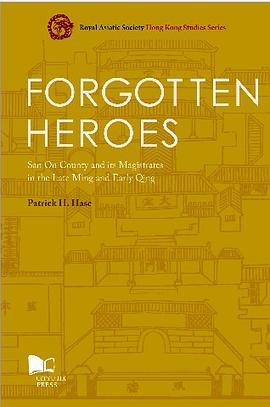

具体描述
This book is an attempt to clarify the history of San On County — the broader Hong Kong area — centring on the troubled years of the sixteenth and seventeenth centuries. It is based on an in-depth study of the San On County Gazetteer, which allows for a detailed discussion of the role, attitudes, and personalities of the San On magistrates, who were the heads of the county administration during this period. Particular focus is given to Zhou Xiyao (magistrate 1640–1644) and Li Kecheng (magistrate 1670–1675). The study finds that they, and at least some of the other magistrates of this period, were genuinely concerned about the county and its people, and tried as best they could to provide good and effective government for them.
The counties (縣, yuen, xian) were the lowest level of the Chinese imperial state structure, and the county magistrates, the heads of the county administration, were in a very real sense the foundation which supported the whole of the rest of the administration. Study of the counties and their administrators is, therefore, of great importance, as well as being a study of great fascination. During 40 years of studying the local history of the New Territories of Hong Kong, the relationship between the villagers and the magistracy has frequently caught my attention, and, my interest thus excited, in due course led to the production of this book.
The central role played by the county magistrates in imperial China has inspired a number of English-language books in recent decades. Among others, T’ung-tsu Chu mostly used handbooks for magistrates, prepared by distinguished Qing scholars, to illustrate his work. John R. Watt produced a masterly work on the magistrates, as seen from the centre, relying particularly on the Qing law code and regulations, but also employing some local material to illuminate such questions as tenure, appointment, and dismissal. Philip C.C. Huang has written two books on the activities of the magistrates as judicial officers in the field of inter-personal, “civil”, legal disputes. There is also a fine study by Linxia Liang on the magistrates as judicial officers in the field of inter-personal legal disputes.
These studies provide an excellent overview of the magistrates and their work. They do not, however, look primarily at the magistrates from the local viewpoint, and so they do not study in detail the magistrates as they functioned within their counties. Several use those local archives that survive (mostly very late nineteenth-century archives from Ba county, 巴縣, that is, the city of Chongqing, 重興, in Sichuan Province; and from Baodi County, 寶抵縣, in Hebei Province, half-way between Tianjin and Peking), as well as central government archives, and some other local sources here and there. However the main aim of all these works is to illuminate the magistrates as a national administrative and judicial institution, taking China as a whole, and not primarily to look at the work of the magistrates within their counties, nor to clarify how they saw and reacted to local problems in those counties.
Clearly, however, the county magistrates were central to the administration and development of their counties, and, as such, also merit detailed study at the local level, as well as on a nationwide basis.
Bradly Reed has prepared a quite superb book (Clerks and “Runners”) which explores the work of magistracy underlings within one particular county (Ba County, the city of Chongqing), at the end of the nineteenth century, but it does not concern itself with the magistrates themselves (except insofar as they managed their underlings), and its setting (a very busy, large, city, a treaty port, at the very end of the imperial period) may well not reflect in its entirety the situation in a small, rural county 250 years earlier.
There were a significant number of handbooks for magistrates written by distinguished scholars in the late Ming and early Qing. One of these, written by Huang Liu-hung (黃六鴻) in 1694, is a particularly down-to-earth and practical work, and gives a good idea of how competent magistrates viewed their work and the problems they actually faced in this period. It has been published in translation; the introduction to this book by the editor, Djang Chu, is a valuable contribution to the study of the magistrates within their counties in the late Ming and early Qing. This manual looks in great depth (in 32 volumes, 卷), totaling 559 pages in translation) at the work of the magistrate within his county. It concentrates, however, on the practice in the north of China (Huang Liu-hung was magistrate in Shantung and Hebei), and the practices described by Huang Liu-hung do not in every respect illustrate practice in the far south. Most of the other handbooks, from this period and later, while they purport to illuminate the problems magistrates might face, and to give advice on dealing with them, are, in fact, almost all “full of moralistic injunctions, with little practical information”, and are of relatively little value in understanding how magistrates in fact operated.
Du Fengzhi (杜鳳治, To Fung-chi) was magistrate of Kwong Ning county (廣寧縣, Guangning), in Kwangtung, in the late Qing; (between 1866 and 1868), and then of Sze Wui county, Kwangtung, (四會, Sehui), and then was once again for a few months in 1870–71 magistrate of Kwong Ning, before being appointed in 1871 as magistrate of the metropolitan county of Nam Hoi (南海, Nanhai: this county covered the western half of Canton city and its western suburbs), where he stayed for some five years, until he was promoted to the prefecture of Law Ting in western Kwangtung (羅定, Luoding). He retired from this post because of ill-health in 1880, at the age of 67. Du Fengzhi left a vast and very detailed diary, (望鳧行館宦粵日記), in 41 volumes, which has recently been published (the second volume of the diary, covering some three months in early 1867, was unfortunately lost during Du Fengzhi’s lifetime). It is particularly illuminating for the period Du Fengzhi spent in Kwong Ning, especially in 1866. Cheung Yin (張研, Zhang Yan) and Yau Tsit (邱捷, Qiu Jie) have written a number of important works on the information available in this diary. This material looks at what Du Fengzhi did, in particular within Kwong Ning county. Kwong Ning was, like San On, a generally quiet and rural county, and these essays, therefore, give a fascinating insight into this late Qing magistrate’s problems, and how he reacted to them: the information thus discussed clarifies, in some respects, the situation in late Ming and early Qing San On.
This current book, like the essays of Yau Chit and the work of Cheung Yin, aims to look at the magistrates of one particular county, San On, but at an earlier period (essentially the period 1573–1713), primarily to attempt to see how the magistrates viewed themselves and their work within that county, how they viewed the problems of that county, and how they set about dealing with those problems, and secondarily to see how the community of that county viewed them and their work. It aims, therefore, to find out what the magistrates were like as individuals and as officials, and what they did, or failed to do, for that county. The book makes no pretentions to do any more than this. The book’s understanding of the general history of China in the late Ming and early Qing is taken from general studies. It likewise takes its understanding of Confucianism and the Confucian “superior man” from general studies.
Apart from the innate fascination of seeing how the San On magistrates functioned when faced with the problems of their county, a major aim of this study is to illuminate part of the pre-British history of the Hong Kong area. Local history, the study of a particular locality, is of great importance. This book is, therefore, intended, at least in part, to throw some light on a vital part of Hong Kong local history and perhaps offer a picture of the magistrates as human figures, struggling with intractable local problems, and, as such, give, it is hoped, a view of them complementary to that given by John R. Watt and Philip C.C. Huang and their colleagues.
The County Gazetteer of San On County (新安縣縣志, Xinan), that is, the county in which the Hong Kong area stood before the coming of the British, with some assistance from the Kwangtung Provincial Gazetteer and the gazetteers of the home counties of the San On magistrates, contains a considerable amount of information which can be used to study the late Ming and early Qing San On magistrates. No archival material from San On is known to survive, and no printed material other than the gazetteers contains anything of marked significance on these officials: almost all that is known of the San On magistrates comes from these publications, without very much in the way of independent supporting evidence. This gives rise to a systemic problem: this study has to use just a tiny handful of sources, and within those sources mostly the writings of the magistrates themselves, along with eulogistic biographies of the magistrates written by scholars of the county, if any such study is to be done. The administrations of these men thus have to be viewed through the eyes of the magistrates themselves, or else through the writings of those who may well have been close to them as community leaders and advisors. Despite these serious problems, however, there seems to be enough evidence to support this study.
The information in the 1688 San On Gazetteer is, in particular, enough to allow a study to be done of the administrations of Zhou Xiyao, who was magistrate between 1640 and 1644, in the late Ming, and Li Kecheng, who was magistrate between 1670 and 1675, in the early Qing, and gives at least some information about some other magistrates in this general period.
This short study of the San On magistrates in the late Ming and early Qing, is intended as a start. Similar studies, such as those of Djang Chu on Huang Liu-hung, and Yau Tsit and Cheung Yin on Du Fengzhi in Kwong Ning, looking at the magistrates in other counties, are desirable, so that a broader-based understanding of these men and their work at the local level can slowly be developed, to put alongside the studies of the magistrates in general as an administrative and judicial national institution. This small book is thus a brick which may one day, together with any other similar studies, form part of a more elaborate and detailed structure.
作者简介
Patrick H. Hase is a researcher into local history. He is the author of The Six-Day War of 1899: Hong Kong in the Age of Imperialism (2008), Custom Land and Livelihood in Rural South China: The Traditional Land Law of Hong Kong’s New Territories, 1750–1950 (2013) and other books and articles on the history and ethnography of the New Territories area. He is a past president and honorary fellow of the Royal Asiatic Society, Hong Kong, and serves as an honorary advisor to museums in Hong Kong, Shenzhen, and Kaiping. He currently lectures part time at Lingnan University History Department.
目录信息
2 The San On Gazetteer: The Magistrates and the County Community
3 The Work of the County Magistrates and Their Magistracies
4 The Ming Magistrates: Zhou Xiyao and His Predecessors
5 Li Kecheng and the Early Qing Magistrates
6 Salt and Fish
7 Corruption
8 Conclusions
· · · · · · (收起)
读后感
用户评价
我必须承认,《Forgotten Heroes》这本书完全颠覆了我对“英雄”的既有认知。在此之前,我脑海中浮现的英雄形象,大多是那些叱咤风云的人物,他们拥有超凡的能力,能够改变历史的走向。然而,这本书却将我带入了一个截然不同的世界,一个由无数个看似渺小却又至关重要的个体所构成的宏大画卷。作者的叙事方式非常独特,他没有选择宏大的笔触去描绘战争或革命,而是将焦点放在了那些身处历史洪流中的普通人身上。我跟随作者的文字,看到了他们在时代的风雨中如何挣扎求生,如何做出艰难的选择,如何在绝望中寻找希望,又如何在平凡的生活中闪耀出人性的光辉。我被书中描绘的那些鲜活的人物形象深深吸引,他们可能只是一个普通的家庭主妇,一个辛勤的农民,一个被埋没的艺术家,或者是一个为了正义而发声的普通市民。然而,正是他们的存在,他们的坚持,他们的付出,在历史的背后,默默地支撑着社会的运转,推动着文明的进步。我尤其欣赏作者对于人物内心世界的深入挖掘,他没有简单地将他们定义为“英雄”,而是展现了他们同样拥有恐惧、疑虑、痛苦和无奈,但即便如此,他们依然选择了坚持,选择了担当。这种真实感,让我对他们产生了深深的共鸣。这本书让我明白,英雄主义并非只有一种模式,它同样存在于那些不被看见的角落,存在于那些默默无闻的奉献之中。它让我重新审视“伟大”这个词的含义,原来,伟大并不一定需要惊天动地的壮举,而可以是日复一日的坚持,是面对困境时的勇气,是即使身处黑暗也依然怀揣光明。阅读《Forgotten Heroes》的过程,是一次关于人性、关于勇气、关于坚持的深刻洗礼,它让我对那些被历史遗忘的生命,充满了敬意和感动。
评分《Forgotten Heroes》这本书,以一种极其触动人心的方式,将我带入了一个全新的历史视角。我一直以来都对那些波澜壮阔的历史事件充满兴趣,但这本书却让我看到了,在那些宏大的叙事背后,同样存在着无数值得我们关注和铭记的个体。作者的叙事技巧非常精湛,他没有简单地罗列事实,而是通过生动的故事,将那些在历史长河中被遗忘的人物,鲜活地展现在我的眼前。我被书中描绘的那些人物所深深吸引,他们可能只是一个默默无闻的医生,一个在战争年代保护孤儿的普通人,一个在科研领域默默奉献的学者,或者是一个为了自由而发出声音的普通公民。作者的笔触细腻而富有感染力,他能够将这些人物的生活细节、他们的情感波动、他们的内心挣扎,都描绘得淋漓尽致,让我仿佛能够与他们产生深刻的共鸣。我从这本书中看到了,历史的进程,并非仅仅由少数伟人所主导,而是无数个普通人的共同努力和牺牲所汇聚而成。每一个被记载的伟大成就背后,都可能隐藏着无数个默默无闻的奉献者。我尤其欣赏作者对于人物性格的深度挖掘,他没有简单地将他们定义为“英雄”,而是展现了他们同样有血有肉,有恐惧,有犹豫,但正是这份真实,让他们更加伟大。阅读《Forgotten Heroes》的过程,是一次关于人性、关于勇气、关于坚持的深刻洗礼,它让我对那些被历史遗忘的生命,充满了敬意和感动。这本书让我明白了,真正的英雄主义,可以体现在任何一个岗位上,任何一个时代里,只要你拥有那份勇气、那份坚持、那份对生命的尊重和对正义的追求。
评分这本书真的让我大开眼界,当我翻开《Forgotten Heroes》的扉页时,我并没有抱有太高的期待,毕竟市面上充斥着各种“英雄”故事,我担心它会落入俗套,充斥着那些我们早已耳熟能详的、被无数次歌颂的伟人传记。然而,这本书以一种令人惊喜的方式打破了我的所有预设。它并非聚焦于那些被历史铭记的、声名显赫的人物,而是将目光投向了那些默默无闻、却在关键时刻发挥了不可替代作用的普通人。这种视角上的转变,为我带来了前所未有的阅读体验。作者的笔触细腻且充满力量,他成功地将那些被遗忘在时光洪流中的个体,鲜活地呈现在我的眼前。我仿佛能听到他们低语的呼吸,感受到他们内心的挣扎与坚守。书中描绘的场景,无论是战火纷飞的战场,还是风雨飘摇的年代,都充满了真实感和画面感。我跟随书中的人物,一同经历了那些跌宕起伏的命运,一同感受了那些复杂而深刻的情感。最让我动容的是,作者并没有刻意去拔高或神化这些“被遗忘的英雄”,而是用一种平和、甚至带着些许悲悯的口吻,去还原他们的生活,去讲述他们的故事。这种真实,反而比任何宏大的叙事都更能触动人心。我发现,原来英雄主义并非只属于那些站在聚光灯下的少数人,它也可以闪耀在每一个普通人的平凡岗位上,体现在每一次微不足道的坚持中。阅读《Forgotten Heroes》的过程,就像是在进行一场深刻的自我对话,它不断地提醒我,在历史的宏大叙事背后,隐藏着无数值得我们去铭记和尊重的灵魂。这本书的价值,远不止于它所讲述的故事本身,更在于它所唤醒的我们对“英雄”概念的重新思考,以及对那些被忽略的、却同样伟大的生命个体的深切关注。我强烈推荐这本书给每一个对历史、对人性,对那些不被看见的伟大力量感兴趣的读者。
评分《Forgotten Heroes》这本书,给我带来的阅读体验是如此的独特和震撼,它完全颠覆了我以往对“英雄”的认知。我一直以来都认为,英雄是那些站在历史舞台中央,接受万众瞩目的人物。然而,这本书却将我带入了历史的幕后,让我看到了那些默默无闻,却支撑起整个时代的平凡身影。作者的叙事风格非常吸引人,他没有选择宏大的笔触去描绘那些耳熟能详的伟人,而是将目光聚焦在那些在历史的洪流中,默默做出贡献,却鲜为人知的个体身上。我被书中那些鲜活的人物形象所深深打动,他们可能只是一个在战场上默默付出的士兵,一个在实验室里不眠不休的科学家,一个在社会变革中传递信息的新闻记者,或者是一个在困境中依然保持善良和勇气的普通市民。作者的笔触细腻而充满力量,他能够将这些人物的生活细节、他们的情感变化、他们的内心挣扎,都描绘得淋漓尽致,让我仿佛能够亲身经历他们的生活,感受他们的喜怒哀乐。这本书让我看到了,历史的进步,并非仅仅依靠少数伟大的个体,而是无数个普通人的共同努力和牺牲所汇聚而成。每一个被记载的伟大成就背后,都可能隐藏着无数个默默无闻的奉献者。我尤其欣赏作者对于人物内心世界的深度挖掘,他并没有简单地将他们定义为“英雄”,而是展现了他们同样有血有肉,有恐惧,有犹豫,但正是这份真实,让他们更加伟大。阅读《Forgotten Heroes》的过程,是一次关于人性、关于勇气、关于坚持的深刻洗礼,它让我对那些被历史遗忘的生命,充满了敬意和感动。这本书让我明白了,真正的英雄主义,可以体现在任何一个岗位上,任何一个时代里,只要你拥有那份勇气、那份坚持、那份对生命的尊重和对正义的追求。
评分《Forgotten Heroes》这本书,就像一股清流,悄无声息地注入了我对历史的认知之中。我一直以来都对那种波澜壮阔、英雄辈出的历史画卷充满着向往,但读过这本书后,我才意识到,真正的史诗,往往隐藏在最不起眼的角落。作者并非刻意煽情,而是用一种冷静而又富有洞察力的笔触,为我揭示了一幅幅生动而真实的画面。我被书中那些鲜活的人物深深吸引,他们可能只是一个普通的士兵,一个坚韧的母亲,一个默默无闻的科学家,或者是一个为了理想而牺牲的普通公民。然而,正是他们的存在,他们的选择,他们的坚持,在历史的洪流中,激起了细微却又至关重要的涟漪。我尤其欣赏作者对于细节的把握,那些生活化的场景,那些人物细微的心理活动,都被描绘得淋漓尽致,让我仿佛置身其中,感同身受。这本书让我看到了历史的另一面,不再是那些被少数伟人主导的宏大事件,而是无数个普通人如何在时代的洪流中,用自己的方式去书写生命,去贡献力量。它让我明白,英雄并非遥不可及,而是存在于我们身边,存在于每一次微小的善良,每一次不屈的抗争,每一次对理想的执着追求之中。阅读的过程,与其说是在“读”一本历史书,不如说是在与一群“人”进行心灵的对话。我为他们的遭遇而忧伤,为他们的坚韧而感动,为他们的选择而深思。这本书让我对“平凡”这两个字有了全新的理解,原来,平凡之中,蕴含着如此巨大的能量和不朽的精神。它不仅拓展了我的历史视野,更触动了我内心深处最柔软的部分,让我开始更加珍视生命中那些看似微不足道的点滴,因为我知道,它们同样可以是构成“英雄”的基石。
评分《Forgotten Heroes》这本书,以一种极其迷人的方式,将我带入了一个全新的历史维度。我一直以来都对那些波澜壮阔的历史事件充满好奇,但这本书却让我看到了,在那些宏大的叙事背后,同样存在着无数值得我们关注和铭记的个体。作者的叙事技巧非常娴熟,他没有简单地罗列事实,而是通过生动的故事,将那些在历史长河中被遗忘的人物,鲜活地展现在我的眼前。我被书中描绘的那些人物所深深吸引,他们可能只是一个默默无闻的工程师,一个在饥荒年代组织救援的普通人,一个在政治动荡中传递真相的记者,或者是一个为了理想而牺牲的艺术家。作者的笔触细腻而富有张力,他能够将这些人物的生活细节、他们的情感波动、他们的内心挣扎,都描绘得淋漓尽致,让我仿佛能够与他们产生深刻的共鸣。我从这本书中看到了,历史的进程,并非仅仅由少数伟人所主导,而是无数个普通人的共同努力和牺牲所汇聚而成。每一个被记载的伟大成就背后,都可能隐藏着无数个默默无闻的奉献者。我尤其欣赏作者对于人物性格的深度挖掘,他没有简单地将他们定义为“英雄”,而是展现了他们同样有血有肉,有恐惧,有犹豫,但正是这份真实,让他们更加伟大。阅读《Forgotten Heroes》的过程,是一次关于人性、关于勇气、关于坚持的深刻洗礼,它让我对那些被历史遗忘的生命,充满了敬意和感动。这本书让我明白了,真正的英雄主义,可以体现在任何一个岗位上,任何一个时代里,只要你拥有那份勇气、那份坚持、那份对生命的尊重和对正义的追求。
评分《Forgotten Heroes》这本书,给我带来的阅读体验是如此的独特而深刻,它完全打破了我以往对英雄故事的刻板印象。我通常认为,英雄总是伴随着耀眼的光环和史诗般的壮举,然而,这本书却将我引向了历史的幕后,让我看到了那些真正支撑起伟大时刻的平凡人物。作者的叙事风格非常引人入胜,他没有使用宏大的叙事框架,而是选择了更加贴近个体生命的故事。我被书中那些鲜活的人物形象所吸引,他们可能是某个重大历史事件中的一个普通参与者,一个在关键时刻做出了不平凡选择的个体,或者是在时代变迁中默默坚守自己信念的人。我惊叹于作者对于细节的把握,他能够将那些琐碎的生活场景,那些人物微妙的情绪变化,描绘得如此生动逼真,让我仿佛能够亲身经历他们的生活,感受他们的喜怒哀乐。这本书让我看到了,英雄并非总是出现在战场上,他们也可能存在于实验室里,存在于教室里,存在于每一个平凡的岗位上。更重要的是,作者并没有将这些人物神化,而是展现了他们同样有血有肉,有恐惧,有犹豫,但正是这份真实,让他们更加伟大。我从中体会到了,真正的英雄主义,往往体现在那些微不足道的坚持,那些不为人知的付出,以及那些在绝望中依然怀抱希望的勇气。这本书让我对“平凡”这两个字有了全新的认识,它告诉我,平凡的生活,同样可以孕育出不平凡的灵魂。它不仅仅是一本历史读物,更是一次关于人性、关于勇气、关于生命意义的深刻反思。我由衷地推荐这本书给所有对历史的深度,对人性的复杂,以及对那些隐藏在伟大事迹背后的默默奉献者感兴趣的读者。
评分《Forgotten Heroes》这本书,以一种极其吸引人的方式,将我带入了一个全新的历史视角。我一直以来都对那些波澜壮阔的历史事件充满兴趣,但这本书却让我看到了,在那些宏大的叙事背后,同样存在着无数值得我们关注和铭记的个体。作者的叙事技巧非常高明,他并没有简单地罗列事实,而是通过生动的故事,将那些在历史长河中被遗忘的人物,鲜活地展现在我的眼前。我被书中描绘的那些人物所深深吸引,他们可能只是一个默默无闻的科学家,一个为了民族存亡而奔走的普通人,一个在战乱中保护无辜的义士,或者是一个为了真理而发出声音的知识分子。作者的笔触细腻而富有力量,他能够将这些人物的生活细节,他们的情感波动,他们的内心挣扎,都描绘得淋漓尽致,让我仿佛能够与他们产生深刻的共鸣。我从这本书中看到了,历史的进程,并非仅仅由少数伟人所主导,而是无数个普通人的共同努力和牺牲所汇聚而成。每一个被记载的伟大成就背后,都可能隐藏着无数个默默无闻的奉献者。我尤其欣赏作者对于人物性格的深度挖掘,他没有简单地将他们定义为“英雄”,而是展现了他们同样拥有普通人的情感和困境,但正是这份真实,让他们更加伟大。阅读《Forgotten Heroes》的过程,是一次关于人性、关于勇气、关于坚持的深刻洗礼,它让我对那些被历史遗忘的生命,充满了敬意和感动。这本书让我明白了,真正的英雄主义,可以体现在任何一个岗位上,任何一个时代里,只要你拥有那份勇气、那份坚持、那份对生命的尊重和对正义的追求。
评分《Forgotten Heroes》这本书,以一种极其令人着迷的方式,将我带入了历史的深处,去发现那些不为人知的闪光点。在我翻开这本书之前,我对历史的理解,更多的是停留在那些被广泛记载的重大事件和杰出人物上。然而,作者的笔触却以一种出人意料的细腻和深刻,为我揭示了历史另一面的真实面貌。他并没有将笔墨花费在那些功勋卓著的领袖身上,而是将目光聚焦在那些在历史的洪流中扮演着关键角色,却鲜为人知的普通人身上。我被书中那些鲜活的人物形象所深深打动,他们可能只是一个在战场上默默无闻的士兵,一个在幕后为研究提供支持的助手,一个在饥荒年代坚守家园的母亲,或者是一个为了传递真相而付出代价的记者。作者用他富有感染力的文字,将这些“被遗忘的英雄”的生命故事,栩栩如生地呈现在我的眼前。我仿佛能够听到他们的喘息,感受到他们的汗水,理解他们的挣扎,更体会到他们内心的坚韧和勇气。这本书让我意识到,历史的进程,并非仅仅由少数伟人所书写,而是无数个普通人的共同努力和牺牲所汇聚而成。每一个被记载的伟大成就背后,都可能隐藏着无数个默默无闻的奉献者。作者对于细节的精妙描绘,以及对于人物内心世界的深刻洞察,都让我对这些“被遗忘的英雄”产生了深深的共鸣和敬意。阅读这本书,不仅仅是一次知识的获取,更是一次情感的触动,一次对“英雄”定义的重新思考。它让我明白了,真正的英雄主义,可以体现在任何一个岗位上,任何一个时代里,只要你拥有那份勇气、那份坚持、那份对生命的尊重和对正义的追求。这本书值得每一个热爱历史,关注人性,以及那些渴望了解隐藏在历史背后伟大力量的人们去阅读。
评分《Forgotten Heroes》这本书,以一种极其深刻且动人的方式,彻底刷新了我对“英雄”的固有认知。过往我接触的英雄故事,大多聚焦于那些在历史的关键节点上,以非凡的智慧和勇气,力挽狂澜的人物,他们如同夜空中最亮的星,耀眼夺目。然而,这本书却将我的视线引向了更为广阔、更为辽远的星空,在那里,闪耀的不仅是少数巨星,更有无数默默燃烧却同样重要的星辰。作者的叙事手法极其高明,他摒弃了那种宏大叙事的传统套路,而是选择了一种更加贴近个体生命,更具人文关怀的视角。我被书中那些鲜活的人物形象深深地吸引,他们可能是某个重大事件中一个微小的齿轮,一个在乱世中坚守良知的普通人,一个在黑暗中传递微弱光明的传递者,或者是一个在平凡岗位上做出不平凡贡献的劳动者。作者的笔触细腻入微,他能够捕捉到人物内心最细微的情感波动,最深刻的挣扎与抉择,以及那些在绝望中依然闪耀的人性光辉。我如同穿越时空,亲身经历他们的生活,感受他们的呼吸,理解他们的选择。这本书让我看到了,历史的真正面貌,并非只有那些被浓墨重彩渲染的事件,更有那些被岁月模糊,被时光遗忘的无数个体,正是他们的存在,他们的坚持,他们的牺牲,共同构成了历史的肌理,支撑起了文明的基石。我由衷地赞叹作者对细节的精准把握,以及对人物内心世界的深刻洞察,这种真实的力量,比任何华丽的辞藻都更能触动人心。阅读《Forgotten Heroes》的过程,对我而言,更像是一次心灵的涤荡,一次对“平凡”与“伟大”关系的深刻理解。它让我明白,英雄主义并非遥不可及,它就蕴藏在每一次微小的善良,每一次不屈的抗争,每一次对理想的执着追求之中。这本书,值得每一个对历史的深度,对人性的复杂,以及对那些隐藏在伟大事迹背后的默默奉献者感兴趣的读者,用心去品读。
评分 评分 评分 评分 评分相关图书







本站所有内容均为互联网搜索引擎提供的公开搜索信息,本站不存储任何数据与内容,任何内容与数据均与本站无关,如有需要请联系相关搜索引擎包括但不限于百度,google,bing,sogou 等
© 2026 onlinetoolsland.com All Rights Reserved. 本本书屋 版权所有