

具體描述
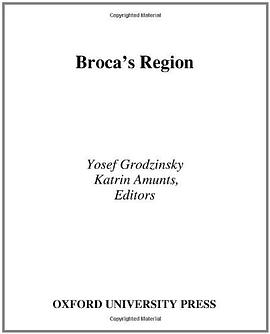
Broca's region has been in the news ever since scientists realized that particular cognitive functions could be localized to parts of the cerebral cortex. Its discoverer, Paul Broca, was one of the first researchers to argue for a direct connection between a concrete behavior--in this case, the use of language--and a specific cortical region. Today, Broca's region is perhaps the most famous part of the human brain, and for over a century, has persisted as the focus of intense research and numerous debates. The name has even penetrated mainstream culture through popular science and the theater. Broca's region is famous for a good reason: As language is one of the most distinctive human traits, the cognitive mechanisms that support it and the tissues in which these mechanisms are housed are also quite complex, and so have the potential to reveal a lot not only about how words, phrases, sentences, and grammatical rules are instantiated in neural tissue, but also, and more broadly, about how brain function relates to behavior. Paul Broca's discoveries were an important, driving force behind the more general effort to relate complex behavior to particular parts of the cerebral cortex, which, significantly, produced the first brain maps. These early studies also, however, suffered from the use of crude techniques, definitions, and distinctions, as well as from ill founded and misdirected assumptions. Although much has been discovered since Broca's work, even today, these problems have not been completely solved. Nonetheless, particularly as a result of important advances made in neuroimaging during the past two decades, Broca's region and all language areas are currently being investigated from every angle. Indeed, as the volume of research into the relations between brain and language has created several communities, each with its own concepts, methods, and considerations, it seemed that it was time to stop, get together, and reflect on the state of the art. This book is the result of that collective reflection, which took place primarily at the Broca's Region Workshop, held in Julich and Aachen, Germany, in June 2004. In it, Yosef Grodzinsky and Katrin Amunts tried to accomplish a nearly impossible task: to mix intellectual traditions and cultures, and juxtapose rather disparate bodies of knowledge, styles of reasoning, and forms of argumentation. Participants were scientists with diverse backgrounds; each invited to contribute his/her particular take, with the hope that a coherent, perhaps even novel, picture would emerge. All of the participants have a special interest in Broca's Region, and represent the myriad angles from which we currently approach it: neuroanatomy, physiology, evolutionary biology, cognitive psychology, clinical neurology, functional imaging, speech and language research, computational biology, and psycho-, neuro-, and theoretical linguistics. The book's main chapters are the contributions of the Workshop's participants and their research teams. Parts of the discussion during the Workshop are included to underscore the richness of viewpoints, and to give readers an idea of the level of interaction that took place. As Broca's region is such an historically significant concept and rich area, this book contains a collection of classic and recent-yet-classic papers. Along with cutting-edge science, Grodzinsky and Amunts want to remind readers of the celebrated past from which much can be learned. The historical chapters include the first two papers written by Paul Broca, as well some work by two of the most important neurologists of the nineteenth century, Ludwig Lichtheim and John Hughlings-Jackson. Also included are parts of twentieth century papers by Korbinian Brodmann, Roman Jakobson, Norman Geschwind, Harold Goodglass, and Jay Mohr. Because this book both reflects the state of the art in Broca's-region research and contains a tribute to its celebrated past, it will be a valuable resource for student and professional researchers. It will also stimulate further interdisciplinary research, which is a significant contribution, as the project called "Broca's region," encompassing the study of brain/language relations, is far from finished.
作者簡介
目錄資訊
讀後感
用戶評價
老實說,這本書的閱讀體驗簡直像是在攀登一座陡峭的山峰,每一步都伴隨著氣喘籲籲和對放棄的渴望,但一旦到達那個階段性的“觀景點”,那種豁然開朗的感覺又是任何平坦大道無法給予的。這本書的行文節奏極其跳躍,有時候會突然插入一些看似與上下文無關的案例研究,或者是一段晦澀難懂的哲學思辨,這讓初次接觸的讀者很容易迷失方嚮。我記得有一章專門討論瞭“失語癥患者的潛意識錶達”,作者用瞭大量的曆史文獻和案例片段進行交叉引用,讀起來需要不斷地在書頁之間來迴跳轉,像是在進行一場偵探式的尋寶遊戲。我個人非常欣賞作者這種不加修飾的、近乎偏執的求證態度,他似乎拒絕接受任何簡化論的解釋,總是將問題推嚮更深、更具爭議性的邊緣。這本書真正震撼我的地方在於它對待“不確定性”的態度。在科學界普遍對大腦的理解還存在諸多空白時,作者毫不避諱地指齣瞭哪些是已知的,哪些是推測的,甚至哪些是完全未解的謎團,這種坦誠是很多同類書籍所缺乏的。它不是在提供一個完美的答案,而是在引導你理解如何去構建一個更強大的提問框架。
评分這本書給我留下的最大印象是其獨特的“時間感”。它似乎超越瞭綫性的敘事,更像是一幅復雜的掛毯,你可以在任何一個點切入,但總能發現它與世界萬物的關聯。我不是神經科學專業的,但由於職業需要(我是一名電影編劇),我對人類情感錶達的底層邏輯非常感興趣。這本書中對某些特定皮層區域功能障礙如何影響敘事結構和情感投射的分析,簡直是為我打開瞭一扇全新的大門。它沒有直接告訴我“如何寫一個好的角色”,而是通過深入剖析大腦的“錯誤”運作模式,反嚮揭示瞭“正常”運作的精妙之處。書中的圖錶和示意圖設計得也極具藝術感,不是那種教科書式的呆闆,而更像是精密儀器的藍圖,充滿瞭動態的美感。我尤其喜歡作者在引言中提到的那個觀點——大腦不是一颱計算機,而是一場持續不斷的、充滿妥協的政治博弈。這種視角讓我開始重新審視我筆下所有角色的動機,那些看似矛盾的行為,在本書的框架下,忽然找到瞭閤理的神經學解釋。
评分這是一部需要被“對待”的書,而不是簡單地“閱讀”的書。我購買的是精裝版,紙張的觸感和油墨的質量都非常上乘,這多少為艱澀的內容增添瞭一絲儀式感。這本書最精妙的地方在於它對科學史的梳理,作者並非僅僅羅列發現,而是將每一個突破都置於當時的曆史、哲學和社會背景下進行審視。這使得我們能理解為什麼某些理論會被接受,而另一些則被拋棄。我感覺自己不是在讀一本現代科學著作,而是在見證一門學科從萌芽到壯大的完整生命周期。在關於情感處理的部分,作者巧妙地引用瞭大量文學和戲劇作品中的片段,用藝術的直觀感受來佐證冷硬的科學數據,這種跨領域的融閤處理得非常自然,毫無牽強之感。這本書的最終價值,我認為不在於它提供瞭多少確鑿的“知識點”,而在於它徹底改變瞭你觀察人類心智的方式,它要求你從更宏大、更具批判性的視角,去解構我們賴以生存的“心智世界”。
评分坦白講,這本書的難度是超乎預期的。我自詡閱讀量不小,但這本書的密度和專業性,實在需要讀者擁有極強的背景知識儲備。我嘗試著在通勤路上閱讀,結果發現那完全是徒勞,每一個句子都像是一個濃縮的知識膠囊,需要靜下心來仔細咀嚼,否則就會囫圇吞棗。書中的術語頻繁齣現,雖然有附錄,但頻繁查閱嚴重打斷瞭閱讀的流暢性。但奇怪的是,盡管過程艱難,我卻無法停止。這本書有一種魔力,它不斷地在挑戰你的認知邊界。它會讓你質疑很多你習以為常的常識——比如我們對“自由意誌”的理解,對“自我”概念的界定。讀完關於記憶編碼和檢索失敗的章節後,我花瞭很長時間去反思自己過去的一些關鍵記憶,突然間感覺那些記憶的“真實性”都變得模糊起來。這本書更像是某種思想的催化劑,它不喂給你魚,而是教你一套識彆魚塘水域結構的方法論。
评分這本書,嗯,怎麼說呢,拿到手的時候就被它那種沉甸甸的分量給吸引住瞭,封麵設計得非常簡約,黑白為主調,讓人有一種直覺的嚴肅感。我一開始是衝著作者的名氣去的,畢竟他在那個領域的研究是齣瞭名的深入和前沿。翻開第一頁,我就被那種精準到近乎冷酷的敘事風格給震住瞭。它不像一般的科普讀物那樣試圖用大量比喻來“討好”讀者,而是直接把核心的概念和復雜的機製像外科手術刀一樣剖開展示給你看。讀到中間部分,關於神經可塑性的那幾章,我感覺自己像是進入瞭一個極其精密的儀器內部,每一個齒輪、每一個綫路的運作都清晰可見,雖然理解起來需要反復咀嚼,但那種智力上的滿足感是無與倫比的。作者似乎並不關心你是否能輕鬆跟上,他隻關心信息的絕對準確性。我花瞭整整一周的時間纔啃完關於語言迴路的那一部分,每讀完一個章節都會閤上書本,望著天花闆發呆好久,試圖將腦海中構建起來的復雜結構定格。這本書更像是一本研究手冊,而不是一本可以消磨時間的休閑讀物,它要求你拿齣百分之二百的專注力,但迴報你的,是對人類思維機製一次近乎顛覆性的重新認識。我嚮所有對大腦科學有嚴肅探究意圖的人推薦它,但請做好準備,這不是一段輕鬆的旅程。
评分 评分 评分 评分 评分相關圖書











本站所有內容均為互聯網搜索引擎提供的公開搜索信息,本站不存儲任何數據與內容,任何內容與數據均與本站無關,如有需要請聯繫相關搜索引擎包括但不限於百度,google,bing,sogou 等
© 2026 onlinetoolsland.com All Rights Reserved. 本本书屋 版权所有