
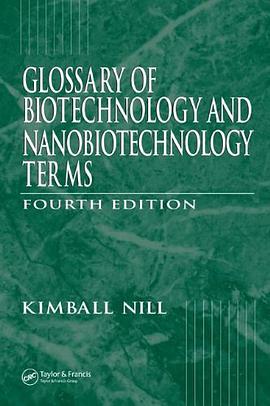

具体描述
Even if you studied biotechnology in school, if you haven't stayed current, it's not likely you'll be able to speak the same language as today's biotech scientists. The same is even truer for nanotechnology where everything gets smaller and smaller, except the terminology required to navigate it. In the Glossary of Biotechnology and Nanobiotechnology Terms, Fourth Edition, Kimball Nill continues to improve upon the reference that for over a decade has helped thousands of professionals, including scientists, attorneys, government workers, lobbyists, venture capitalists, and university tech transfer staff, to communicate successfully with those working on the cutting edge of modern science. Now in its fourth edition, Nill has taken the much appreciated step of adding nanotechnology to his glossary. Just by casually perusing the Glossary of Biotechnology and Nanobiotechnology Terms, Fourth Edition you will learn a number of enlightening facts. Even those in related sciences will be surprised to discover what the language unveils. The Glossary of Biotechnology and Nanobiotechnology Terms, Fourth Edition is a handy reference designed for people with little or no training in the biological and chemical sciences, as well as scientists communicating from other disciplines. Unlike other glossaries, this one is both informative and completely accessible. Instead of looking up one term to end up mired in equally difficult terminology, this intelligently designed volume follows what the author refers to as a Reference Chain that steadily leads you to simpler more common terminology, down to a level that anyone with a high school education will be able to understand. The definitions are written utilizing words that enable you to conceptualize the idea embodied in the term, with explanations based on analogy whenever possible. Consider this example: Suppose you just received a funding request, a faculty memo, or patent concern that refers to A-DNA, which happens to be the first definition in the Glossary. A-DNA A particular right-handed helical form of DNA (possessing 11 base pairs per turn), which is the form that DNA molecules exist in when they are partially dehydrated. A-form DNA is found in fibers at 75% relative humidity and requires the presence of sodium, potassium, or cesium as the counterion. Instead of lying flat, the bases are tilted with respect to the helical axis, and there are more base pairs per turn. The A-form is biologically interesting because it is probably very close to the conformation adopted by DNA-RNA hybrids or by RNA-RNA double-stranded regions. The reason is that the presence of the 2'2 hydroxyl group prevents RNA from lying in the B-form. See also B-DNA, DNA-RNA HYBRID, DEOXYRIBONUCLEIC ACID (DNA), BASE PAIR (bp) But then after looking at the above definition, you wonder what exactly is a DNA-RNA Hybrid? DNA-RNA Hybrid A double helix that consists of one chain of DNA hydrogen-bonded to a chain of RNA by means of complementary base pairs. See also HYBRIDIZATION (MOLECULAR GENETICS), HYBRIDIZATION (PLANT GENETICS), DOUBLE HELIX ...however while you've often heard mention of a double helix, you were never quite sure what that meant...Double Helix The natural coiled conformation of two complementary, antiparallel DNA chains. This structure was first put forward by Watson and Crick in 1953. See also DEOXYRIBONUCLEIC ACID (DNA) And that might brings you to ask, Do you really actually know what DNA is? Deoxyribonucleic Acid (DNA) Discovered by Frederick Miescher in 1869, it is the chemical basis for genes. The chemical building blocks (molecules) of which genes (i.e., paired nucleotide units that code for a protein to be produced by a cell's machinery, such as its ribosomes) are constructed. Every inherited characteristic has its origin somewhere in the code of the organism's complement of DNA. The code is made up of subunits called nucleic acids. The sequence of the four nucleic acids is interpreted by certain molecular systems in order to produce the proteins required by an organism. The structure of the DNA molecule was elucidated in 1953...The Glossary of Biotechnology and Nanobiotechnology Terms, Fourth Edition is packed with over 400 pages of exceptionally well-organized and cross-referenced terminology, making it an essential reference for anyone working directly or indirectly with those pioneering the frontiers of modern biology.
作者简介
目录信息
读后感
用户评价
相关图书

















本站所有内容均为互联网搜索引擎提供的公开搜索信息,本站不存储任何数据与内容,任何内容与数据均与本站无关,如有需要请联系相关搜索引擎包括但不限于百度,google,bing,sogou 等
© 2026 onlinetoolsland.com All Rights Reserved. 本本书屋 版权所有