
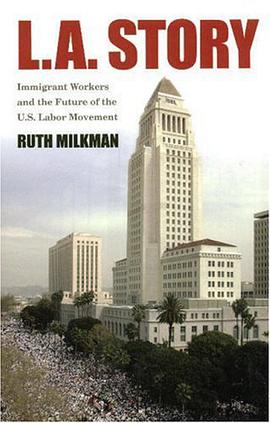

具体描述
Sharp decreases in union membership over the last fifty years have caused many to dismiss organized labor as irrelevant in today’s labor market. In the private sector, only 8 percent of workers today are union members, down from 24 percent as recently as 1973. Yet developments in Southern California—including the successful Justice for Janitors campaign—suggest that reports of organized labor’s demise may have been exaggerated. In L.A. Story, sociologist and labor expert Ruth Milkman explains how Los Angeles, once known as a company town hostile to labor, became a hotbed for unionism, and how immigrant service workers emerged as the unlikely leaders in the battle for workers’ rights.
L.A. Story shatters many of the myths of modern labor with a close look at workers in four industries in Los Angeles: building maintenance, trucking, construction, and garment production. Though many blame deunionization and deteriorating working conditions on immigrants, Milkman shows that this conventional wisdom is wrong. Her analysis reveals that worsening work environments preceded the influx of foreign-born workers, who filled the positions only after native-born workers fled these suddenly undesirable jobs. Ironically, L.A. Story shows that immigrant workers, who many union leaders feared were incapable of being organized because of language constraints and fear of deportation, instead proved highly responsive to organizing efforts. As Milkman demonstrates, these mostly Latino workers came to their service jobs in the United States with a more group-oriented mentality than the American workers they replaced. Some also drew on experience in their native countries with labor and political struggles. This stock of fresh minds and new ideas, along with a physical distance from the east-coast centers of labor’s old guard, made Los Angeles the center of a burgeoning workers’ rights movement.
Los Angeles’ recent labor history highlights some of the key ingredients of the labor movement’s resurgence—new leadership, latitude to experiment with organizing techniques, and a willingness to embrace both top-down and bottom-up strategies. L.A. Story’s clear and thorough assessment of these developments points to an alternative, high-road national economic agenda that could provide workers with a way out of poverty and into the middle class.
作者简介
Ruth Milkman is professor of sociology and director of the Institute of Industrial Relations at the University of California, Los Angeles.
目录信息
读后感
用户评价
整体而言,这本书给我留下了深刻而美好的印象。它像一位久违的老友,在安静的午后,与我分享了许多动人的故事和深刻的感悟。我喜欢它独特的风格,喜欢它精湛的技巧,更喜欢它所传递出的那种温暖而又充满力量的情感。读完这本书,我感觉自己的内心被一种淡淡的满足感所填满,仿佛完成了一次心灵的旅行。我一定会向身边的朋友们推荐这本书,因为我相信,每个人都能在这本书中找到属于自己的那份感动和启示。
评分这本书带给我的不仅仅是故事本身,更是一种思考和启迪。作者在字里行间流露出的对生活、对社会、对人生的独特见解,让我受益匪浅。我常常会在读到某些段落时停下来,反复咀嚼作者的观点,然后开始反思自己过去的一些看法,甚至开始审视自己的生活方式。这种能够引发深度思考的书籍,才是真正有价值的。它就像一位睿智的长者,在静静地诉说着人生的智慧,而我则是一个虚心求教的学生,从中汲取养分,努力让自己变得更加成熟和豁达。
评分这本书的封面设计就吸引了我,那种略带复古的印刷风格,加上书名“L.A. Story”的字体选择,仿佛一股老电影的氛围扑面而来,让人忍不住想一探究竟。拿到手里,纸张的质感也很舒服,不是那种过于光滑的,而是带着些许纹理,拿在手里有一种踏实的感觉。我一直对那些讲述城市故事的书籍抱有浓厚的兴趣,特别是像洛杉矶这样充满传奇色彩的城市,它的光鲜背后隐藏着多少不为人知的故事?我非常期待作者能带我走进一个真实的、鲜活的洛杉矶,而不是那些被过度美化或妖魔化的版本。我希望能在字里行间感受到这座城市的脉搏,听到它低语的秘密,看到它在日夜交替中的变幻。这本书能否成功地捕捉到这种精髓,是我最期待的。
评分阅读这本书的过程,就像是经历了一场跌宕起伏的情感之旅。作者的文字时而激昂澎湃,让我心潮澎湃;时而又细腻入微,触动心底最柔软的地方。我发现自己在不经意间就跟着角色的喜怒哀乐而起伏,为他们的遭遇感到担忧,为他们的成就而欣喜。这种强烈的共鸣感,证明了作者在塑造人物和构建情节上的高超技巧。我尤其欣赏作者对人性复杂性的深刻挖掘,那些看似普通的人物身上,都闪烁着真实的光芒,他们的选择,他们的挣扎,都充满了人性的光辉与阴影,让我从中看到了许多自己的影子。
评分这本书的开篇让我眼前一亮,作者的叙事方式非常独特,像是在娓娓道来一段陈年的往事,又像是在循循善诱地引导读者进入一个全新的视野。我立刻被那种细腻的笔触所吸引,仿佛置身于某个特定的场景之中,能够嗅到空气中弥漫的气息,听到远处传来的喧嚣。作者对于细节的捕捉能力令人赞叹,无论是对人物神态的描绘,还是对环境氛围的渲染,都显得那么真实而生动,让我感觉自己不再是一个旁观者,而是故事的一部分。这种沉浸式的阅读体验是很难得的,我迫不及待地想知道接下来的故事会如何发展,人物的命运又将走向何方。
评分虎头蛇尾
评分虎头蛇尾
评分虎头蛇尾
评分"Si, Se Puede": Union Organizing Strategies and Immigrant Workers
评分"Si, Se Puede": Union Organizing Strategies and Immigrant Workers
相关图书









本站所有内容均为互联网搜索引擎提供的公开搜索信息,本站不存储任何数据与内容,任何内容与数据均与本站无关,如有需要请联系相关搜索引擎包括但不限于百度,google,bing,sogou 等
© 2026 onlinetoolsland.com All Rights Reserved. 本本书屋 版权所有