
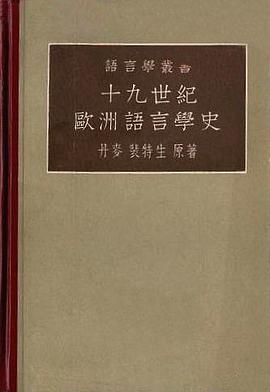

具体描述
作者简介
Holger Pedersen (linguist)
来自 维客
Jump to: navigation, search
Holger Pedersen [hʌlg̊ɐ ˈpʰeð̪ˀɐsn̩] was a Danish linguist who made significant contributions to language science and wrote about 30 authoritative works concerning several languages.
He was born in Gelballe, Denmark on April 7, 1867 and died in Copenhagen on October 25, 1953.
Pedersen received his doctorate in 1897 from the University of Copenhagen and stayed on there as a professor.
Among students of the Celtic languages he is best known for his Vergleichende Grammatik der keltischen Sprachen, "Comparative Grammar of the Celtic Languages," which is still regarded as the major reference work in Celtic historical linguistics.
Two of his theories have been receiving considerable attention in recent times after decades of neglect, often known today under the names of the Nostratic/Eurasiatic theory and the glottalic theory.
目录 [隐藏]
1 Origin of the Nostratic theory
2 Origin of the glottalic theory
3 Works of Holger Pedersen mentioned in this article
4 References
5 External links
[编辑]Origin of the Nostratic theory
Pedersen seems to have first used the term "Nostratian" in an article on Turkish phonology published in 1903. Today, it has been replaced by the term "Nostratic."
Pedersen's definition of Nostratian is as follows (1931:338):
As a comprehensive designation for the families of languages which are related to Indo-European, we may employ the expression Nostratian languages (from Latin nostrās "our countryman").
In his view, Indo-European was most clearly related to Finno-Ugric and Samoyed, with "similar, though fainter, resemblances" to Turkish, Mongolian, and Manchu; to Yukaghir; and to Eskimo (1931:338). He also considered Indo-European might be related to Semitic and that, if so, it must be related to Hamitic and possibly to Basque (ib.).
In modern terms, we would say he was positing genetic relationship between Indo-European and the Uralic, Altaic, Yukaghir, Eskimo, and Afro-Asiatic language families. (The existence of the Altaic family is controversial, and few would now assign Basque to Afro-Asiatic.)
However, in Pedersen's view the languages listed did not exhaust the possibilities for Nostratian (ib.):
The boundaries for the Nostratian world of languages cannot yet be determined, but the area is enormous, and includes such widely divergent races that one becomes almost dizzy at the thought. (...) The question remains simply whether sufficient material can be collected to give this inclusion flesh and blood and a good clear outline.
[编辑]Origin of the glottalic theory
In a work published in 1951, Pedersen pointed out that the frequency of b in Indo-European is abnormally low. Comparison of languages, however, shows that it would be normal if it had once been the equivalent voiceless stop p, which is infrequent or absent in many languages.
He also posited that the Indo-European voiced aspirates, bh dh gh, could be better understood as voiceless aspirates, ph th kh.
Pedersen therefore proposed that the three stop series of Indo-European, p t k, bh dh gh, and b d g, had at an earlier time been b d g, ph th kh, and (p) t k, with the voiceless and voiced non-aspirates reversed.
This theory attracted relatively little attention until the American linguist Paul Hopper (1973) and the two Soviet scholars Thomas V. Gamkrelidze and Vyacheslav V. Ivanov proposed, in a series of articles culminating in a major work by Gamkrelidze and Ivanov published in 1984 (English translation 1995), that the Indo-European b d g series had in fact been originally a glottalized series, p' t' k'. Under this form, the theory has attracted wide interest. There seems to be a good chance that it will endure in one form or another.
[编辑]Works of Holger Pedersen mentioned in this article
1903. "Türkische Lautgesetze," in Zeitschrift der Deutschen Morgenländischen Gesellschaft 57, 535-561.
1909-1913. Vergleichende Grammatik der keltischen Sprachen, 2 volumes. Göttingen: Vandenhoeck and Ruprecht.
1931. Linguistic Science in the Nineteenth Century: Methods and Results, translated from the Danish by John Webster Spargo. Cambridge, Massachusetts: Harvard University Press.
1951. Die gemeinindoeuropäischen und die vorindoeuropäischen Verschlusslaute. Det Kongelige Danske Videnskabernes Selskab, Historisk-filologiske Meddelelser 32.5. Copenhagen.
[编辑]References
Paul J. Hopper, “Glottalized and murmured occlusives in Indo-European.” Glossa 7,2 (1973):141-166.
Thomas V. Gamkrelidze and Vjačeslav V. Ivanov, Indo-European and the Indo-Europeans, 2 volumes. Berlin and New York: Mouton de Gruyter, 1995 (original Russian edition 1984).
目录信息
读后感
看到此书和译者、校对者的介绍,一定是见猎心喜。但粗粗翻过,确是专名翻译错误百出。 试举例:爱塞俄比亚、菲尼基、安哥拉(应是Ankara安卡拉)、苏美利亚(苏美尔)、希太特(赫梯)喀露兹替(犍陀罗)。读之,如白饭上着乌蝇。
评分看到此书和译者、校对者的介绍,一定是见猎心喜。但粗粗翻过,确是专名翻译错误百出。 试举例:爱塞俄比亚、菲尼基、安哥拉(应是Ankara安卡拉)、苏美利亚(苏美尔)、希太特(赫梯)喀露兹替(犍陀罗)。读之,如白饭上着乌蝇。
评分看到此书和译者、校对者的介绍,一定是见猎心喜。但粗粗翻过,确是专名翻译错误百出。 试举例:爱塞俄比亚、菲尼基、安哥拉(应是Ankara安卡拉)、苏美利亚(苏美尔)、希太特(赫梯)喀露兹替(犍陀罗)。读之,如白饭上着乌蝇。
评分看到此书和译者、校对者的介绍,一定是见猎心喜。但粗粗翻过,确是专名翻译错误百出。 试举例:爱塞俄比亚、菲尼基、安哥拉(应是Ankara安卡拉)、苏美利亚(苏美尔)、希太特(赫梯)喀露兹替(犍陀罗)。读之,如白饭上着乌蝇。
评分看到此书和译者、校对者的介绍,一定是见猎心喜。但粗粗翻过,确是专名翻译错误百出。 试举例:爱塞俄比亚、菲尼基、安哥拉(应是Ankara安卡拉)、苏美利亚(苏美尔)、希太特(赫梯)喀露兹替(犍陀罗)。读之,如白饭上着乌蝇。
用户评价
本书在论述理论的同时,也非常注重对历史背景的还原。我读到关于普鲁士科学院以及其他学术机构在十九世纪欧洲语言学发展中所扮演的角色时,深感震撼。这些机构不仅为学者们提供了研究的平台和资源,更是当时学术交流和思想碰撞的重要场所。书中对于不同国家在语言学研究上的侧重点和发展路径的比较,也极具启发性。比如,德国学派对历史语言学的精深研究,法国在语言结构分析上的独到之处,以及英国在语音学和方言学方面的贡献。作者并没有将这些孤立地呈现,而是将它们置于更广阔的社会、文化和政治背景下进行解读,让我们看到学术研究是如何受到时代的影响,又如何反过来影响时代。我尤其对书中关于“语言民族主义”的讨论感到兴趣,它深刻地揭示了语言在构建民族认同中的重要作用,以及当时一些学者如何在历史的洪流中,试图通过语言研究来塑造国家身份。
评分当我读到关于索绪尔的章节时,我简直被深深吸引住了。作者用一种非常生动的方式,呈现了索绪尔思想的革命性。他不再将语言视为静态的系统,而是强调其动态性和社会性,尤其是“能指”与“所指”的关系,以及“语言”与“言语”的区分,这些概念的提出,无疑是对传统语言学的一次颠覆。我尤其对书中关于语言符号的任意性这一观点的讨论印象深刻,它解释了为什么不同语言会有如此巨大的差异,也让我们看到语言的演变并非完全是偶然的,而是受到社会约定俗成的影响。作者还对比了索绪尔的思想与当时其他重要语言学家的观点,这种比较分析,使得索绪尔的独特性和前瞻性更加凸显。这本书不仅仅是介绍历史,它更是在引导读者思考语言的本质,以及语言在人类认知和交流中的根本作用。我感觉自己仿佛参与了一场思想的盛宴,受益匪浅。
评分刚翻开这本《十九世纪欧洲语言学史》,原本以为会是一部沉闷枯燥的学术大部头,没想到读起来却像是在探险。作者没有一开始就抛出那些晦涩难懂的术语和理论,而是像一位经验丰富的导游,先带着我们漫步在十九世纪欧洲的文化土壤上。他细致地描绘了当时社会思潮的涌动,民族主义的兴起如何影响了人们对语言的认知,以及启蒙运动的理性精神如何渗透到语言研究的方方面面。我尤其喜欢他描写的那些语言学家们,他们不仅仅是埋头书斋的学者,更像是那个时代的思想家,他们对语言的探索,往往与对人类起源、民族身份、甚至社会进步的思考紧密相连。这种宏观的视角,让原本可能冰冷抽象的语言学史,变得鲜活而富有温度。书中穿插的各种历史轶事和学者之间的辩论,也让阅读过程充满了趣味性,仿佛置身于那个思想碰撞的时代,感受着知识的萌芽和演进。这本书让我对语言这个人类最伟大的发明,有了更深刻、更全面的理解,也重新认识了语言学研究的魅力所在。
评分这本书的叙事方式非常引人入胜,尤其是其中对一些关键概念的引入和阐述。读到关于印欧语系假说的部分,作者并没有直接给出结论,而是娓娓道来,从不同的学者如何观察到相似的词汇和语法结构,如何一步步地构建起这个影响深远的理论框架。他详尽地展示了当时所依赖的证据,以及后来证据的不断丰富和修正。这种循序渐进的讲解,让非专业读者也能清晰地理解这些复杂的学术问题,并且能够体会到科学探索的严谨性和创造性。书中还探讨了历史比较法在当时语言学研究中的核心地位,以及它如何深刻地改变了人们对语言演变规律的认识。通过对不同语言之间关系的梳理,作者揭示了人类社会发展的脉络,也让我们看到了语言作为文化载体的力量。我特别欣赏作者在处理不同学派观点时的客观公正,他既肯定了他们的贡献,也指出了他们局限性,让读者能够形成自己独立的判断。
评分整本书读下来,我最大的感受是,语言学并非象牙塔里的孤芳自赏,而是与人类文明的方方面面息息相关。作者在讲述语言学发展的历程中,也穿插了许多关于教育、翻译、文学批评等领域的话题。例如,他讨论了十九世纪民族语言的标准化进程,这直接关系到国民教育的普及和民族文化的传播。他还触及了不同语言之间交流的困境与可能,以及文学作品如何通过翻译跨越语言的界限,在不同文化之间产生影响。这本书让我认识到,语言学不仅仅是对语言本身的分析,更是对人类思维方式、文化传承和社会互动方式的深刻探索。作者在结尾处的总结,更是让我对语言学的未来发展充满了期待,也更加坚信,对语言的理解,就是对人类自身的理解。这本书不仅为我打开了认识十九世纪欧洲语言学的大门,更重要的是,它激发了我对语言这一奇妙事物的持续好奇心。
评分翻译有问题-虽然是袁夫人手笔
评分翻译有问题-虽然是袁夫人手笔
评分翻译有问题-虽然是袁夫人手笔
评分翻译有问题-虽然是袁夫人手笔
评分翻译有问题-虽然是袁夫人手笔
相关图书







本站所有内容均为互联网搜索引擎提供的公开搜索信息,本站不存储任何数据与内容,任何内容与数据均与本站无关,如有需要请联系相关搜索引擎包括但不限于百度,google,bing,sogou 等
© 2026 onlinetoolsland.com All Rights Reserved. 本本书屋 版权所有