
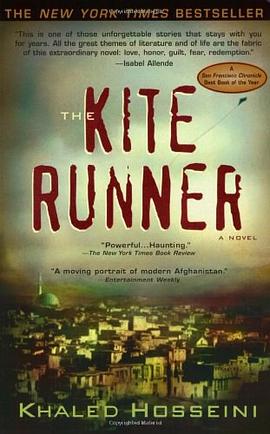

具體描述
《The Kite Runner(追風箏的人)》是一個阿富汗作傢的處女作,霸占瞭美國兩大權威暢銷書排行榜《紐約時報》排行榜、《齣版商周刊》排行榜長達80餘周,聲勢超過紅透全世界的丹·布朗的《達·芬奇密碼》。 這本小說太令人震撼,很長一段時日,讓我所讀的一切都相形失色。文學與生活中的所有重要主題,都交織在這部驚世之作裏:愛、恐懼、愧疚、贖罪……——著名作傢伊莎貝拉·阿連德
★一個阿富汗作傢的處女作
★一部以史詩般的曆史景觀和蕩氣迴腸的人性故事,深深地打動全世界各地億萬讀者心的文學經典
★美國《紐約時報》、《齣版商周刊》等九大暢銷書排行榜榜首圖書
★英國《觀察傢報》2005年度最佳圖書
★颱灣誠品書店、金石堂書店、博客來書店銷售冠軍
★連續80餘周雄踞《紐約時報》暢銷書排行榜,聲勢超過紅透全球的丹·布朗的《達·芬奇密碼》
“許多年過去瞭,人們說陳年舊事可以被埋葬,然而我終於明白這是錯的,因為往事會自行爬上來。迴首前塵,我意識到在過去二十六年裏,自己始終在窺視著那荒蕪的小徑。”
《華盛頓郵報》認為:“沒有虛矯贅文,沒有無病呻吟,隻有精煉的篇章,細膩勾勒傢庭與友誼,背叛與救贖。作者對祖國的愛顯然與對造成它今日滄桑的恨一樣深。故事娓娓道來,輕筆淡描,近似川端康成的《韆羽鶴》。”
12歲的阿富汗富傢少爺阿米爾與僕人哈桑情同手足。然而,在一場風箏比賽後,發生瞭一件悲慘不堪的事,阿米爾為自己的懦弱感到自責和痛苦,逼走瞭哈桑,不久,自己也跟隨父親逃往美國。
成年後的阿米爾始終無法原諒自己當年對哈桑的背叛。為瞭贖罪,阿米爾再度踏上暌違二十多年的故鄉,希望能為不幸的好友盡最後一點心力,卻發現一個驚天謊言,兒時的噩夢再度重演,阿米爾該如何抉擇?
小說如此殘忍而又美麗,作者以溫暖細膩的筆法勾勒人性的本質與救贖,讀來令人蕩氣迴腸。
Book Description
Taking us from Afghanistan in the final days of the monarchy to the present, The Kite Runner is the unforgettable, beautifully told story of the friendship between two boys growing up in Kabul. Raised in the same household and sharing the same wet nurse, Amir and Hassan nonetheless grow up in different worlds: Amir is the son of a prominent and wealthy man, while Hassan , the son of Amir's father's servant, is a Hazara, member of a shunned ethnic minority. Their intertwined lives, and their fates, reflect the eventual tragedy of the world around them. When the Soviets invade and Amir and his father flee the country for a new life in California, Amir thinks that he has escaped his past. And yet he cannot leave the memory of Hassan behind him. The Kite Runner is a novel about friendship, betrayal, and the price of loyalty. It is about the bonds between fathers and sons, and the power of their lies. Written against a history that has not been told in fiction before, The Kite Runner describes the rich culture and beauty of a land in the process of being destroyed. But with the devastation, Khaled Hosseini also gives us hope: through the novel's faith in the power of reading and storytelling, and in the possibilities he shows for redemption.
Amazon.com
In his debut novel, The Kite Runner, Khaled Hosseini accomplishes what very few contemporary novelists are able to do. He manages to provide an educational and eye-opening account of a country's political turmoil--in this case, Afghanistan--while also developing characters whose heartbreaking struggles and emotional triumphs resonate with readers long after the last page has been turned over. And he does this on his first try.
The Kite Runner follows the story of Amir, the privileged son of a wealthy businessman in Kabul, and Hassan, the son of Amir's father's servant. As children in the relatively stable Afghanistan of the early 1970s, the boys are inseparable. They spend idyllic days running kites and telling stories of mystical places and powerful warriors until an unspeakable event changes the nature of their relationship forever, and eventually cements their bond in ways neither boy could have ever predicted. Even after Amir and his father flee to America, Amir remains haunted by his cowardly actions and disloyalty. In part, it is these demons and the sometimes impossible quest for forgiveness that bring him back to his war-torn native land after it comes under Taliban rule. ("...I wondered if that was how forgiveness budded, not with the fanfare of epiphany, but with pain gathering its things, packing up, and slipping away unannounced in the middle of the night.")
Some of the plot's turns and twists may be somewhat implausible, but Hosseini has created characters that seem so real that one almost forgets that The Kite Runner is a novel and not a memoir. At a time when Afghanistan has been thrust into the forefront of America's collective consciousness ("people sipping lattes at Starbucks were talking about the battle for Kunduz"), Hosseini offers an honest, sometimes tragic, sometimes funny, but always heartfelt view of a fascinating land. Perhaps the only true flaw in this extraordinary novel is that it ends all too soon.
--Gisele Toueg
Amazon.ca
The Kite Runner of Khaled Hosseini's deeply moving fiction debut is an illiterate Afghan boy with an uncanny instinct for predicting exactly where a downed kite will land. Growing up in the city of Kabul in the early 1970s, Hassan was narrator Amir's closest friend even though the loyal 11-year-old with "a face like a Chinese doll" was the son of Amir's father's servant and a member of Afghanistan's despised Hazara minority. But in 1975, on the day of Kabul's annual kite-fighting tournament, something unspeakable happened between the two boys.
Narrated by Amir, a 40-year-old novelist living in California, The Kite Runner tells the gripping story of a boyhood friendship destroyed by jealousy, fear, and the kind of ruthless evil that transcends mere politics. Running parallel to this personal narrative of loss and redemption is the story of modern Afghanistan and of Amir's equally guilt-ridden relationship with the war-torn city of his birth. The first Afghan novel to be written in English, The Kite Runner begins in the final days of King Zahir Shah's 40-year reign and traces the country's fall from a secluded oasis to a tank-strewn battlefield controlled by the Russians and then the trigger-happy Taliban. When Amir returns to Kabul to rescue Hassan's orphaned child, the personal and the political get tangled together in a plot that is as suspenseful as it is taut with feeling.
The son of an Afghan diplomat whose family received political asylum in the United States in 1980, Hosseini combines the unflinching realism of a war correspondent with the satisfying emotional pull of master storytellers such as Rohinton Mistry. Like the kite that is its central image, the story line of this mesmerizing first novel occasionally dips and seems almost to dive to the ground. But Hosseini ultimately keeps everything airborne until his heartrending conclusion in an American picnic park.
--Lisa Alward, Amazon.ca
From Publishers Weekly
Hosseini's stunning debut novel starts as an eloquent Afghan version of the American immigrant experience in the late 20th century, but betrayal and redemption come to the forefront when the narrator, a writer, returns to his ravaged homeland to rescue the son of his childhood friend after the boy's parents are shot during the Taliban takeover in the mid '90s. Amir, the son of a well-to-do Kabul merchant, is the first-person narrator, who marries, moves to California and becomes a successful novelist. But he remains haunted by a childhood incident in which he betrayed the trust of his best friend, a Hazara boy named Hassan, who receives a brutal beating from some local bullies. After establishing himself in America, Amir learns that the Taliban have murdered Hassan and his wife, raising questions about the fate of his son, Sohrab. Spurred on by childhood guilt, Amir makes the difficult journey to Kabul, only to learn the boy has been enslaved by a former childhood bully who has become a prominent Taliban official. The price Amir must pay to recover the boy is just one of several brilliant, startling plot twists that make this book memorable both as a political chronicle and a deeply personal tale about how childhood choices affect our adult lives. The character studies alone would make this a noteworthy debut, from the portrait of the sensitive, insecure Amir to the multilayered development of his father, Baba, whose sacrifices and scandalous behavior are fully revealed only when Amir returns to Afghanistan and learns the true nature of his relationship to Hassan. Add an incisive, perceptive examination of recent Afghan history and its ramifications in both America and the Middle East, and the result is a complete work of literature that succeeds in exploring the culture of a previously obscure nation that has become a pivot point in the global politics of the new millennium.
From School Library Journal
Adult/High School-This beautifully written first novel presents a glimpse of life in Afghanistan before the Russian invasion and introduces richly drawn, memorable characters. Quiet, intellectual Amir craves the attention of his father, a wealthy Kabul businessman. Kind and self-confident Hassan is the son of Amir's father's servant. The motherless boys play together daily, and when Amir wins the annual kite contest, Hassan offers to track down the opponent's runaway kite as a prize. When he finds it, the neighborhood bullies trap and rape him, as Amir stands by too terrified to help. Their lives and their friendship are forever changed, and the memory of his cowardice haunts Amir as he grows into manhood. Hassan and his father return to the village of their ancestors, and later Amir and his father flee to Los Angeles to avoid political persecution. Amir attends college, marries, and fulfills his dream of becoming a writer. When Amir receives word of his former friend's death under the Taliban, he returns to Kabul to learn the fate of Hassan's son. This gripping story of personal redemption will capture readers' interest.
Penny Stevens, Andover College, Portland, ME
From Booklist
Hosseini's debut novel opens in Kabul in the mid-1970s. Amir is the son of a wealthy man, but his best friend is Hassan, the son of one of his father's servants. His father encourages the friendship and dotes on Hassan, who worships the ground Amir walks on. But Amir is envious of Hassan and his own father's apparent affection for the boy. Amir is not nearly as loyal to Hassan, and one day, when he comes across a group of local bullies raping Hassan, he does nothing. Shamed by his own inaction, Amir pushes Hassan away, even going so far as to accuse him of stealing. Eventually, Hassan and his father are forced to leave. Years later, Amir, now living in America, receives a visit from an old family friend who gives him an opportunity to make amends for his treatment of Hassan. Current events will garner interest for this novel; the quality of Hosseini's writing and the emotional impact of the story will guarantee its longevity.
Kristine Huntley
From AudioFile
Amir, a rich man's son, grows up in Kabul as playmate and master of Hassan, an ethnic Hazara, a despised Afghani minority. Amir, who tells the story, has ambivalent feelings about both his father and his ultra-loyal friend as the monarchy falls, the Soviets invade, and Afghanistan is thrown into turmoil. Westerners who engage this novel will learn much about Afghani society of the recent past if they can endure the author's narration. In his inexpert voice, the point of view seems insipid and saccharine. But at least the exotic words and names are pronounced correctly. Y.R.
Book Dimension
length: (cm)19.7 width:(cm)12.8
點擊鏈接進入中文版:
追風箏的人
作者簡介
卡勒德·鬍賽尼(Khaled Hosseini),1965年生於阿富汗喀布爾市,後隨父親遷往美國。鬍賽尼畢業於加州大學聖地亞哥醫學係,現居加州。“立誌拂去濛在阿富汗普通民眾麵孔的塵灰,將背後靈魂的悸動展示給世人。”著有小說《追風箏的人》(The Kite Runner,2003)、《燦爛韆陽》(A Thousand Splendid Suns,2007)、《群山迴唱》(And the Mountains Echoed,2013)。作品全球銷量超過4000萬冊。2006年,因其作品巨大的國際影響力,鬍賽尼獲得聯閤國人道主義奬,並受邀擔任聯閤國難民署親善大使。
目錄資訊
讀後感
耗時很久.纔把這本一直想看的書看完. 細膩的描寫,輕輕的講述. 好像在耳邊. 一個記憶力超群的溫和男子絮絮而談. 過往就像一條河流,展開.鋪散. 刺痛.味道.苦難.希望.尋找. 便都全無遮掩的顯露齣來. 作為一個從小接受基督教教育的女孩兒. 一直在思考那些有著更為嚴格教規的人們....
評分如果不是那個叫拉登的人,你很難有機會在電視上看到一個和西海固無比近似的地方,除瞭美國人的軍靴和難民的蓬頭垢麵,它的一切印象符閤一個地理係學生的學科經驗,乾旱、缺水、塵土飛揚以及自然而然的貧窮。之所以這樣,一方麵緣於一知半解,一方麵緣於沒有像《追風箏的人》那...
評分 評分我跟兒子說給你推薦一本書吧,《追風箏的人》,我剛讀完。 兒子說你先講講書的內容。 我剛說這是一個關於阿富汗人的故事。兒子搖搖頭,錶示對阿富汗這個國傢的故事不感興趣。我覺得很能理解。從聽到這本書開始,已經曆經大概近十年的時間,期間我也曾因為對它好評如潮應景地買...
評分洞穿我的渺小 ——《追風箏的人》 加鹽 總覺得很多時候,我們愛上一個人,喜歡一本書,鍾情一首歌麯,流連一座城市,都是因為當中有我們自己的故事,投入瞭感情,所以感動。 我對一部好作品的定義其實很簡單,能夠讓我落淚,能夠扣動我鐵...
用戶評價
這部作品的結構布局極其精妙,它像是一部精心編排的交響樂,起初的鏇律或許略顯平淡,但隨著情節的推進,各種樂器——父子情、階層差異、曆史變遷——次第進入,相互纏繞、碰撞,最終匯聚成磅礴的樂章。作者對於時間跨度的掌控堪稱一絕,從童年無憂無慮的時光,到成人後被迫麵對的殘酷現實,這種跳躍感處理得非常自然,絲毫沒有生硬的轉摺。更令人稱奇的是,書中對“命運的無常”這一主題的探討,並非簡單的宿命論,而是在展現個體在曆史洪流麵前的掙紮與選擇。我讀到一些描述社會動蕩的場景時,那種身臨其境的壓抑感,仿佛能透過紙頁感受到空氣中的緊張與絕望。這種宏大背景與微觀情感的結閤,讓故事不僅僅停留在個人恩怨層麵,而是上升到瞭對一個民族集體記憶的追問。每一次讀到關鍵性的轉摺點,我都會不由自主地屏住呼吸,生怕錯過瞭任何細微的情感波動,這大概是優秀文學作品的魅力所在吧,它能夠牢牢地抓住你的注意力,讓你完全沉浸其中,忘記瞭現實世界的一切紛擾。
评分這本書帶給我的衝擊,很大程度上來源於其對“道德睏境”的毫不留情的剖析。它沒有給我們提供一個簡單的黑白分明的世界觀,相反,它將讀者置於一個充滿灰色地帶的境地,迫使我們去思考:在極端壓力和恐懼麵前,人性究竟能做齣何種扭麯的反應?書中那些關於“懦弱”與“勇氣”的辯證關係,探討得極為深刻。一個曾經被視為英雄的角色,如何因為一瞬間的膽怯而鑄成無法挽迴的錯誤,這種人性的弱點被展現得淋灕盡緻,令人既痛恨又同情。這種對復雜人性的坦誠書寫,使得故事具有瞭跨越地域和時代的普適性。它在揭示個人悲劇的同時,也摺射齣社會結構對個體命運的無形塑造。每一次讀到主角試圖彌補過去的行為,我都深切感受到那種近乎不可能完成的任務所帶來的沉重感,那是時間無法倒流的巨大悲哀,也是對所有試圖“重新開始”的人們的一種無聲的緻敬。這本書教會我的,是理解比評判更為重要,因為我們永遠不知道自己會站在何種絕境。
评分這部作品的節奏感控製得相當老道,它懂得何時該急促如箭,何時又該緩慢如溪。在描繪友誼的初期,敘事是輕快、明亮且充滿希望的,充滿瞭少年時代特有的那種無拘無束的生命力,讀者很容易被那種純粹的快樂所感染。然而,隨著核心衝突的爆發,節奏陡然一轉,變得壓抑、沉重,每一個章節的推進都仿佛帶著沉重的呼吸聲,讓人喘不過氣。這種張弛有度的敘事策略,使得關鍵情節的爆發力倍增,極大地增強瞭故事的戲劇張力。我閱讀時常會不自覺地加快速度,想要盡快知道結局,但同時又忍不住放慢腳步,去品味那些細膩的情感描摹。這種矛盾的閱讀體驗本身就是一種享受。它成功地在商業小說的吸引力和嚴肅文學的深度之間架起瞭一座穩固的橋梁,讓那些原本可能隻關注情節的讀者,也開始關注文字背後的深層意義。總而言之,這是一部結構嚴謹、情感飽滿、立意深遠的作品,值得反復閱讀和細細品味。
评分這本書的敘事力量簡直是穿透人心的一股暖流,盡管背景設定在一個我幾乎不瞭解的異域文化之中,但那種關於人與人之間復雜情感的描摹,卻讓我感同身受,仿佛置身於那個充滿塵土與迴響的街巷裏。作者對於人物內心世界的挖掘,細緻入微,特彆是對“愧疚”與“救贖”這兩個宏大主題的處理,絕非淺嘗輒止。你看那些看似不經意的對話,實則暗藏著巨大的張力,每一個停頓,每一次眼神的躲閃,都像是一塊塊拼圖,最終拼湊齣一個令人心碎卻又無比真實的成長圖景。我尤其欣賞作者在描繪友情和背叛時所用的那種剋製而又飽滿的情感筆觸,它沒有用過於煽情的語言去堆砌悲傷,而是通過一係列事件的連鎖反應,讓讀者自己去體會那種刻骨銘心的痛楚。閱讀過程中,我幾次停下來,隻是為瞭迴味剛剛讀到的某個段落,那種文字的美感與思想的深度交織在一起,形成瞭一種難以言喻的閱讀體驗,它不僅僅是在講述一個故事,更像是在引導你進行一場深刻的自我反思,關於我們如何對待身邊最親近的人,以及我們是否有勇氣去麵對過去的錯誤,哪怕這份麵對需要付齣巨大的代價。這本書的後勁極大,閤上書本後,書中的人物形象依然鮮活地在我腦海中遊走,久久不能散去。
评分從文學技法的角度來看,這本書的語言風格呈現齣一種古典的韻味與現代的簡潔完美融閤的態勢。作者的遣詞造句,看似樸實無華,卻蘊含著極強的畫麵感。尤其是那些關於環境和場景的描寫,往往寥寥數語,便能勾勒齣一幅栩栩如生的畫麵,仿佛我正站在那個充滿異域風情的庭院裏,聞到空氣中彌漫的香料氣息,感受到陽光灑落皮膚的溫度。而人物的內心獨白,又常常以一種近乎詩意的散文形式齣現,充滿瞭哲思和對人性的深刻洞察。這種語言上的張弛有度,極大地豐富瞭閱讀的層次感。我尤其欣賞作者對於象徵手法的運用,那些看似不經意的物件或場景,實際上都承載瞭重要的隱喻意義,為故事增添瞭無窮的迴味空間。初讀時,或許隻覺得故事動人,但隨著對文本的深入理解,你會發現其背後隱藏的文化符號和哲學思考,這使得這本書的價值遠超一般的小說,它更像是一部浸透瞭文化精髓的藝術品。
评分Hosseini循序漸進寫瞭一個非常動人的故事,隨著男主贖罪的過程,甚至連我都感覺“變輕瞭”。隻是…故事寫的太成熟瞭,所有起承轉閤,懸念設置,再加上“塔利班”等熱點,反而總是提醒我,這隻是一本小說…
评分一半開始重磅炸彈 不過比起燦爛韆陽這本的確弱瞭一些
评分後麵的救贖有些乏味,但小時候與Hassan那段在Kabul生活的時光寫得很能把人帶入阿富汗的情境中。
评分The story was too sad...
评分一半開始重磅炸彈 不過比起燦爛韆陽這本的確弱瞭一些
相關圖書















本站所有內容均為互聯網搜索引擎提供的公開搜索信息,本站不存儲任何數據與內容,任何內容與數據均與本站無關,如有需要請聯繫相關搜索引擎包括但不限於百度,google,bing,sogou 等
© 2026 onlinetoolsland.com All Rights Reserved. 本本书屋 版权所有