
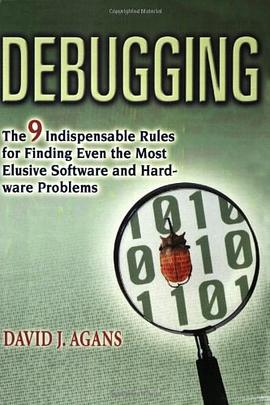

具体描述
This book was born in 1981 when a group of test technicians at Gould asked me if I could write a
document on how to troubleshoot our hardware products. I was at a loss—the products were boards
with hundreds of chips on them, several microprocessors, and numerous communications buses. I
knew there was no magical recipe; they would just have to learn how to debug things. I discussed
this with Mike Bromberg, a long time mentor of mine, and we decided the least we could do was
write up some general rules of debugging. The Ten Debugging Commandments were the result, a
single sheet of brief rules for debugging which quickly appeared on the wall above the test benches.
Over the years, this list was compressed by one rule and generalized to software and systems, but
it remains the core of this book. So to Mike, and to the floor techs who expressed the need, thanks.
Over the years, I've had the pleasure of working for and with a number of inspirational people who
helped me develop both my debugging skills and my sense of humor. I'd like to recognize Doug
Currie, Scott Ross, Glen Dash, Dick Morley, Mike Greenberg, Cos Fricano, John Aylesworth (one of
the original techs), Bob DeSimone, and Warren Bayek for making challenging work a lot of fun. I
should also mention three teachers who expected excellence and made learning enjoyable: Nick
Menutti (it ain't the Nobel Prize, but here's your good word), Ray Fields, and Professor Francis F.
Lee. And while I never met them, their books have made a huge difference in my writing career:
William Strunk Jr. and E. B. White (The Elements of Style), and Jeff Herman and Deborah Adams
(Write the Perfect Book Proposal).
To the Delt Dawgs, my summer softball team of 28 years and counting, thanks for the reviews and networking help. I'm indebted to Charlie Seddon, who gave me a detailed review with many helpful
comments, and to Bob Siedensticker, who did that and also gave me war stories, topic suggestions,
and advice on the publishing biz. Several people, most of whom I did not know personally at the
time, reviewed the book and sent me nice letters of endorsement, which helped get it published.
Warren Bayek and Charlie Seddon (mentioned above), Dick Riley, Bob Oakes, Dave Miller, and
Professor Terry Simkin: thank you for your time and words of encouragement.
I'm grateful to the Sesame Workshop, Tom and Ray Magliozzi (Click and Clack of Car Talk—or is it
Clack and Click?), and Steve Martin for giving me permission to use their stories and jokes; to Sir
Arthur Conan Doyle for creating Sherlock Holmes and having him make so many apropos
comments; and to Seymour Friedel, Bob McIlvaine, and my brother Tom Agans for relating interesting war stories. And for giving me the examples I needed both to discover the rules and to
demonstrate them, thanks to all the war story participants, both heroes and fools (you know who
you are).
Working with my editors at Amacom has been a wonderful and enlightening experience. To Jacquie
Flynn and Jim Bessent, thank you for your enthusiasm and great advice. And to the designers and
other creative hands in the process, nice work; it came out great.
Special appreciation goes to my agent, Jodie Rhodes, for taking a chance on a first−time author
with an offbeat approach to an unfamiliar subject. You know your markets, and it shows.
For their support, encouragement, and countless favors large and small, a special thanks to my
in−laws, Dick and Joan Blagbrough. To my daughters, Jen and Liz, hugs and kisses for being fun
and believing in me. (Also for letting me have a shot at the computer in the evenings between
high−scoring games and instant messenger sessions.)
And finally, my eternal love and gratitude to my wife Gail, for encouraging me to turn the rules into a
book, for getting me started on finding an agent, for giving me the time and space to write, and for
proofreading numerous drafts that I wouldn't dare show anyone else. You can light up a chandelier
with a vacuum cleaner, but you light up my life all by yourself.
作者简介
Dave Agans is a 1976 MIT graduate whose engineering career spans large companies such as
Gould, Fairchild, and Digital Equipment; small startups, including Eloquent Systems and Zydacron;
and independent consulting for a variety of clients. He has held most of the customary individual
contributor titles as well as System Architect, Director of Software, V.P. Engineering, and Chief
Technical Officer. He has played the roles of engineer, project manager, product manager, technical
writer, seminar speaker, consultant, and salesman.
Mr. Agans has developed successful integrated circuits, TV games, industrial controls, climate
controls, hotel management systems, CAD workstations, handheld PCs, wireless fleet dispatch
terminals, and videophones. He holds two U.S. patents. On the non−technical side, he is a
produced musical playwright and lyricist.
Dave currently resides in Amherst, New Hampshire, with his wife, two daughters, and (when they
decide to come inside) two cats. In his limited spare time, he enjoys musical theatre, softball,
playing and coaching basketball, and writing.
目录信息
读后感
一般当工程师把一个东西称为艺术甚至玄学的时候,说明这个东西难度很大,没有太多规律可以遵循,调试就属于此列。几乎每个程序员都有被bug搞到死去活来的经验,有时候颠来倒去,问题似乎解决了,但也不知道为什么,就把它当作不可解释的玄学现象,最烦人的一种bug是偶尔出现难...
评分 评分书里面讲的案例都很有共鸣,其实调试方法软硬件是通用的. 就拿我一直在用的windows 10 insider Preview 来说吧. 我明知道这是一个埋伏着各种bug的系统, 但仍然是用的乐此不疲. windows 新系统现每个月至少更新一次, 频繁的时候三五天就更新一版(MIUI开发版也差不多, 正常情况下,...
评分一般当工程师把一个东西称为艺术甚至玄学的时候,说明这个东西难度很大,没有太多规律可以遵循,调试就属于此列。几乎每个程序员都有被bug搞到死去活来的经验,有时候颠来倒去,问题似乎解决了,但也不知道为什么,就把它当作不可解释的玄学现象,最烦人的一种bug是偶尔出现难...
评分五星!力荐!! 对于一本被冷落的经典,我觉得这还是远远不够的!我很希望能有更多的人了解这本书,从而从中学到一些东西。 说实话,看到豆瓣里这本书"2人读过,2人想读"的统计结果,我感到十分的诧异。在我看来,这绝对是一本软件调试领域的经典作品,相信很多人都读过《设计...
用户评价
《Debugging》这本书的标题就充满了力量,仿佛是开发者们在面对代码迷宫时的指路明灯。我是一名对技术充满热情的自由职业者,经常需要独立解决各种开发难题。我希望这本书能够提供一套实用的、可操作的调试框架,帮助我快速有效地定位和修复bug。我特别期待书中能够分享一些不同编程语言和开发环境下的通用调试策略,以及针对特定场景下的优化技巧。我想要学习如何利用版本控制系统来追踪bug的引入,如何使用单元测试和集成测试来验证代码的正确性,以及如何利用静态代码分析工具来提前发现潜在的问题。我更希望书中能够探讨一些关于调试的“哲学”,例如如何保持冷静和耐心,如何从错误中学习,以及如何培养良好的编程习惯来减少bug的产生。这本书的价值,不仅仅在于它提供的技术知识,更在于它能够帮助我提升解决问题的能力和效率,成为一名更优秀的开发者。
评分拿到《Debugging》这本书,我首先被它沉甸甸的质感所吸引。这不仅仅是一本书,更像是一本武林秘籍,一本关于如何驾驭代码世界中那些狡猾的“妖魔鬼怪”的宝典。我是一名有着几年开发经验的程序员,深知bug如同影随形,有时会让你怀疑人生的意义。我希望这本书能为我提供一套系统性的解决方案,从底层原理到高级技巧,面面俱到。我期待它能够深入探讨各种类型的bug,例如逻辑错误、内存泄漏、并发问题等等,并提供相应的分析工具和策略。我特别感兴趣的是书中关于如何构建高效的测试用例,以及如何利用自动化工具来捕捉bug的章节。毕竟,预防胜于治疗,如果能提早发现并修复bug,将大大提高开发效率。另外,我也希望书中能够分享一些关于团队协作中如何进行bug管理和沟通的经验,毕竟,一个人的力量是有限的,集体的智慧才能更好地解决复杂问题。这本书的出现,无疑为我提供了一个宝贵的学习机会,我渴望通过它,提升自己的调试能力,成为一名更具价值的开发者。
评分这是一本让我心动不已的《Debugging》。在数字化的浪潮中,我们享受着科技带来的便利,却也常常被隐藏在代码深处的bug所困扰。我是一名热爱思考的技术爱好者,对事物背后的原理有着天然的探究欲。我希望这本书能够深入浅出地剖析bug的根源,从计算机底层原理到高级编程范式,为我打开一扇全新的视角。我期待书中能够探讨那些“难以捉摸”的bug,比如那些只在特定环境下才会出现的间歇性问题,或者那些由多个组件交互引起的复杂bug。我希望能够学习到如何运用更高级的分析工具,例如性能分析器、内存探测器等,来发现那些隐藏在代码深处的性能瓶颈和资源滥用。我也对书中关于如何设计易于调试的代码,以及如何构建健壮的错误处理机制的章节充满兴趣。这本书不仅仅是关于解决现有问题,更是关于如何避免问题的发生,如何构建更加可靠和优雅的软件。
评分《Debugging》这本书的封面设计充满了力量感,仿佛预示着它将为读者带来解决问题的强大能力。我是一位刚入行不久的初级开发者,经常被各种各样的bug搞得焦头烂额。我希望这本书能够像一位循循善诱的老师,从最基础的概念讲起,一步步引导我理解bug的产生原因,掌握各种调试工具的使用方法。我想要学习如何利用IDE提供的调试功能,如何设置断点,如何单步执行代码,如何查看变量的值等等。我还希望书中能够介绍一些常用的调试技巧,比如如何有效地使用打印语句,如何分析堆栈信息,如何使用日志来追踪程序的执行流程。对于我来说,理解bug的本质比单纯地解决一个bug更重要。我希望这本书能够帮助我培养一种严谨的思维方式,让我能够从根本上理解问题,而不是仅仅停留在表面。这本书的到来,让我对未来的学习充满了期待,我相信它将成为我编程之路上一位不可或缺的伙伴。
评分终于收到这本期待已久的《Debugging》了!迫不及待地拆开包装,那厚实的纸张和精致的封面就让我心情愉悦。我一直对软件开发过程中那些“看不见的敌人”——bug——充满好奇,也曾因此废寝忘食。这本书的出现,仿佛是一束光,照亮了我迷茫的探索之路。我希望它能像一位经验丰富的导师,循循善诱地引导我理解bug产生的根源,掌握分析和定位的技巧,甚至能够预测和规避潜在的问题。我特别期待书中能够分享一些真实世界的案例,那些在代码海洋中沉浮的开发者们是如何披荆斩棘,最终找到罪魁祸首的。我想要学习那些经典的调试方法论,比如二分查找法、日志分析、断点调试等等,并希望书中能深入剖析这些方法的原理和适用场景。当然,我也憧憬着能够从中领略到一些“黑客思维”,用更加巧妙和高效的方式解决棘手的bug。这本书不仅仅是关于技术的,更是关于一种解决问题的思维方式,一种在混乱中寻找秩序的艺术。我希望在阅读完这本书后,我能够更加自信地面对那些让人头疼的bug,并且在未来的开发生涯中,能够成为一个更加卓越的“bug猎人”。
评分9 goldern rules for debugging
评分手上的bug要还是解决不了就把书烧了
评分书中有关于debug的9条黄金规则 呵呵 我想成为debug大师
评分指导原则而已, 没什么干货
评分fun reading
相关图书



本站所有内容均为互联网搜索引擎提供的公开搜索信息,本站不存储任何数据与内容,任何内容与数据均与本站无关,如有需要请联系相关搜索引擎包括但不限于百度,google,bing,sogou 等
© 2026 onlinetoolsland.com All Rights Reserved. 本本书屋 版权所有