
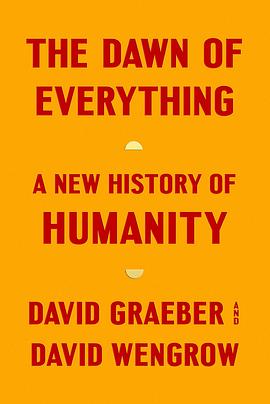

具体描述
A trailblazing account of human history, challenging our most fundamental assumptions about social evolution--from the development of agriculture and cities to the emergence of the state, political violence, and social inequality--and revealing new possibilities for human emancipation.
For generations, our remote ancestors have been cast as primitive and childlike--either free and equal innocents, or thuggish and warlike. Civilization, we are told, could be achieved only by sacrificing those original freedoms or, alternatively, by taming our baser instincts. David Graeber and David Wengrow show how such theories first emerged in the eighteenth century as a conservative reaction to powerful critiques of European society posed by Indigenous observers and intellectuals. Revisiting this encounter has startling implications for how we make sense of human history today, including the origins of farming, property, cities, democracy, slavery, and civilization itself.
Drawing on pathbreaking research in archaeology and anthropology, the authors show how history becomes a far more interesting place once we learn to throw off our conceptual shackles and perceive what's really there. If humans did not spend 95 percent of their evolutionary past in tiny bands of hunter-gatherers, what were they doing all that time? If agriculture, and cities, did not mean a plunge into hierarchy and domination, then what kinds of social and economic organization did they lead to? What was really happening during the periods that we usually describe as the emergence of the state? The answers are often unexpected, and suggest that the course of human history may be less set in stone, and more full of playful, hopeful possibilities, than we tend to assume.
The Dawn of Everything fundamentally transforms our understanding of the human past and offers a path toward imagining new forms of freedom, new ways of organizing society. This is a monumental book of formidable intellectual range, animated by curiosity, moral vision, and a faith in the power of direct action.
Includes Black-and-White Illustrations
作者简介
David Graeber was a professor of anthropology at the London School of Economics. He is the author of Debt: The First 5,000 Years and Bullshit Jobs: A Theory, and was a contributor to Harper's Magazine, The Guardian, and The Baffler. An iconic thinker and renowned activist, his early efforts in Zuccotti Park made Occupy Wall Street an era-defining movement. He died on September 2, 2020.
David Wengrow is a professor of comparative archaeology at the Institute of Archaeology, University College London, and has been a visiting professor at New York University. He is the author of three books, including What Makes Civilization?. Wengrow conducts archaeological fieldwork in various parts of Africa and the Middle East.
目录信息
读后感
元现代主义(Metamodernism)是发展的最后阶段吗?混沌理论可能是答案 作者:Hanzi Freinacht,原文:https://medium.com/@hanzifreinacht/is-metamodernism-the-last-stage-of-development-meta-meme-chaos-theory-might-hold-the-answer-ddb27ad8889a 混沌不是阶梯--但阶梯是通...
评分I have been taking on a long vacation without any jobs (kind of aimless), this book has been such a pleasure to read. It is already turning out to be the most powerful read for me in 2022. I mean, who wouldn't love a book that finally argues that agricultur...
评分[https://athenacool.wordpress.com/2021/12/02/the-dawn-of-everything/] The Dawn of Everything: A New History of Humanity 万物黎明:新人类史 David Graeber, David Wengrow / Farrar, Straus and Giroux / 2021-11 子扉我 2021年小雪 申城西楼 原载[回响编辑部]微信2021...
评分 评分I have been taking on a long vacation without any jobs (kind of aimless), this book has been such a pleasure to read. It is already turning out to be the most powerful read for me in 2022. I mean, who wouldn't love a book that finally argues that agricultur...
用户评价
这本书最令人耳目一新的地方,在于它成功地融合了人类学、考古学、社会学乃至哲学思辨的跨学科视野,但却没有沦为任何一门学科的注脚。它有一种近乎于叛逆的学术精神,敢于直面主流叙事中最脆弱的部分。阅读体验是动态的,它不像教科书那样给你一个既定的框架,反而像是一个极其耐心的引导者,陪着你一起在人类文明的广阔荒原上寻觅脚印。它对“自我驯化”过程的剖析尤其深刻,揭示了我们是如何一步步放弃了某些可能更具活力或自由的生存方式,来换取某种形式的“安全感”或“稳定”。读完之后,你会发现自己看待邻居、看待社区、看待政府的方式都悄悄地发生了一些微妙的偏移。那种对既定秩序的质疑,不再是空洞的口号,而是建立在扎实的历史证据和逻辑推演之上的。它是一部能真正改变你看待“日常”的书。
评分真正让我感到震撼的是它对“我们是谁”这个宏大命题的挑战。它拒绝给出一个简单的答案,而是提供了一整套工具箱,让读者自己去构建关于人类本质的理解。很多时候,读到一些关于早期人类政治生活的描述,我脑海中会自然而然地浮现出当代政治的影子,然后立刻被作者打断——“不,他们不是这样想的”。这种不断地自我纠错、不断地跨越时空去理解他者处境的过程,本身就是一种智力上的冒险。它揭示了我们今天所珍视的许多“普世价值”,在人类历史的大部分时间里,其实都是不存在的、甚至是外来的构建物。这本书不提供慰藉,它提供的是一种清醒的、有时甚至略带痛苦的觉察:我们以为自己是宇宙的中心,但其实只是众多可能性中刚刚选中了某一个分支的结果。这种对“必然性”的解构,让阅读体验变得异常扎实且充满回味。
评分这本书的开篇就带着一种宏大的史诗感,仿佛作者不是在讲述历史,而是在重塑我们对人类文明起源的认知。它没有那种刻板的年代时间线,反而像是一幅不断展开的、色彩斑斓的挂毯,上面绣满了来自世界各个角落的、关于早期社会形态的生动片段。我尤其欣赏它对“进步”这一概念的颠覆性解读。我们习惯性地认为,从狩猎采集到农业社会,再到城邦国家的出现,是一条单向度的、不可逆转的上升曲线。然而,作者却巧妙地展示了那些被主流叙事边缘化的可能性——那些看似“倒退”的社会选择,在特定的环境和哲学观照下,可能蕴含着更深层次的自由与智慧。阅读的过程中,我数次停下来,不是因为内容晦涩,而是因为那些被精心布置的“思想陷阱”让我不得不重新审视自己根深蒂固的预设。它迫使你跳出那种将人类历史视为“必然宿命”的视角,去拥抱一种更加开放、更加充满岔路的理解。那种感觉,就像是在一个熟悉的花园里,突然发现了一扇通往未知领域的密门,充满了对未竟之境的好奇与向往。
评分这本书的叙事节奏处理得非常高明,它不像传统的人类学著作那样沉闷地堆砌考古发现,而是充满了文学性的张力和辩论的热情。作者们似乎一直在与那些僵化的学术权威进行一场精彩的“思想对弈”。他们引用了大量鲜为人知的民族志资料,将那些被历史洪流冲刷殆尽的社会实验重新带回到聚光灯下。特别是关于“权力”和“等级”的起源部分,简直是醍醐灌顶。我们总以为不平等是人类社会的原罪,是生存竞争的必然产物,但书中呈现的那些高度复杂、却又刻意避免了永久性集权统治的社群结构,让人不禁要问:我们是否过于早地接受了“权力集中即效率”的教条?文笔的切换也很有特点,时而像一个雄辩的哲学家,逻辑严密地拆解既有理论;时而又像一个经验丰富的旅行家,用充满画面感的语言描绘那些遥远部落的生活场景。这种游刃有余的风格,让原本严肃的学术探讨变得极具可读性和吸引力。
评分从结构上看,这本书的体量是相当可观的,但其内在的脉络却出奇地清晰,如同精密的钟表机械。它并非线性叙事,而是围绕几个核心议题——如城市、起源、社会形态、自由——进行了多次螺旋上升的探讨。每一次回归到核心主题时,都会因为之前介绍的新的案例和视角而增添新的层次感。我特别喜欢它对“乌托邦”的重新定义。以往我们认为乌托邦是遥不可及的幻想,是现实的反面。但在书中,那些被描绘的早期社会,其实就是无数个“当下可行”的、虽然短暂但却真实存在过的“反抗资本主义或专制统治的实践场”。它们不是对未来的憧憬,而是对自身选择的证明。这种将历史的“非主流”瞬间放大为理解“主流”的关键钥匙的做法,体现了作者深厚的洞察力。它让你意识到,历史不是被写定的,而是由无数次被遗忘的、微小的“拒绝”所共同塑造的。
评分https://athenacool.wordpress.com/2021/12/02/the-dawn-of-everything/
评分书是好书。可我实在不感兴趣。读完50%,弃掉,有缘再见。
评分书是好书。可我实在不感兴趣。读完50%,弃掉,有缘再见。
评分花了一个月读完,想打999颗星。重新讲述了人类史,证明了我们对社会进化论的想象只是一种迷思。西方现代政治体制绝对不是历史的终结,人类完全有能力想象出真正平等的组织形式并将其付诸实践。
评分历史叙述不太靠谱,甚至夸大和曲解现有的考古研究成果,只是为了宣扬他们的无政府主义主张。出于我自己的理论习惯,我对人类学无政府主义的抵触在于,如果脱离法律和权威的概念,自由和平等不过是空洞的想象罢了。感觉是就像是福山观点的对立面。
相关图书








本站所有内容均为互联网搜索引擎提供的公开搜索信息,本站不存储任何数据与内容,任何内容与数据均与本站无关,如有需要请联系相关搜索引擎包括但不限于百度,google,bing,sogou 等
© 2026 onlinetoolsland.com All Rights Reserved. 本本书屋 版权所有